Reinforcement-aware distillation for LLM reasoning
This paper proposes reinforcement-aware knowledge distillation to improve LLM reasoning, but the abstract provides no benchmark numbers.

This paper proposes reinforcement-aware knowledge distillation to improve LLM reasoning, but the abstract provides no benchmark numbers.
- Research org: Unspecified in arXiv abstract
- Core data: No benchmark numbers in abstract
- Breakthrough: Reinforcement-aware knowledge distillation for LLM reasoning
For engineers building or deploying reasoning models, the interesting part here is not a new benchmark table but a training idea: use reinforcement-aware distillation to transfer reasoning behavior more deliberately. The paper is about LLM reasoning, so the practical question is whether a student model can learn not just outputs, but the reasoning patterns that lead to better outputs.
The source material is thin, so the safest reading is also the most honest one: this paper introduces a method and frames it around reasoning, but the abstract does not give the usual details developers would want, such as task names, exact datasets, baselines, or evaluation scores. That means you should treat it as a method proposal until you can inspect the full paper.
What problem this paper is trying to fix
Get the latest AI news in your inbox
Weekly picks of model releases, tools, and deep dives — no spam, unsubscribe anytime.
No spam. Unsubscribe at any time.
Knowledge distillation is a familiar trick: train a smaller model to imitate a stronger teacher. The catch is that for reasoning tasks, copying final answers is often not enough. A model can match outputs on some examples while still failing to internalize the process that produced them.

That is the gap this paper appears to target. The title signals that the authors want distillation to be sensitive to reinforcement learning signals, which suggests they are trying to preserve or transfer reasoning behavior more effectively than plain imitation.
For developers, that matters because reasoning quality is often where smaller models break down first. If distillation can capture the structure of successful reasoning, it could be more useful than a standard teacher-student setup that only compresses surface-level behavior.
How the method works in plain English
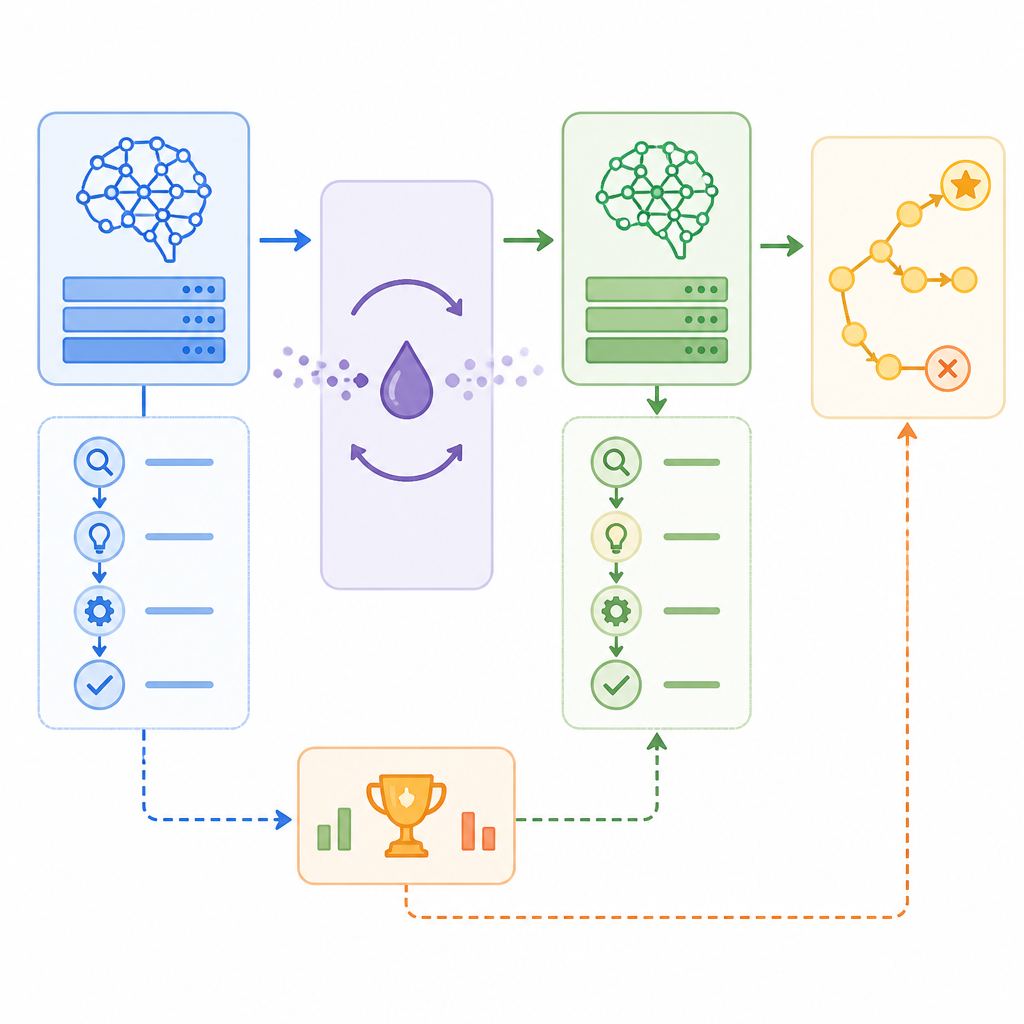
Based on the title alone, the method combines two ideas: reinforcement learning and knowledge distillation. In plain English, that usually means the teacher’s behavior is shaped by reinforcement-style feedback, and the student is trained to absorb what the teacher learned from that feedback.
The key phrase is “reinforcement-aware.” That implies the distillation process is not blind copying. Instead, it likely accounts for which outputs or reasoning trajectories are better according to a reinforcement signal, then uses that information during training.
What makes that different from ordinary distillation is the emphasis on the learning signal, not just the teacher’s final answer. For reasoning models, that can be important because the same answer can be reached through different paths, and some paths may generalize better than others.
What the paper actually shows
Here is the honest limitation: the abstract provided in the source does not include benchmark numbers, datasets, or comparison results. So there is no way to report an accuracy gain, pass rate, or efficiency improvement without guessing.
That does not mean the paper has no results; it means the raw abstract does not expose them. If you are evaluating this for adoption, you would need the full paper to see whether the method improves reasoning quality, distillation efficiency, or both.
In practical terms, the absence of numbers also means there is no evidence here about cost. We do not know whether the approach requires more training compute, more complex teacher signals, or extra tuning compared with standard distillation.
- Benchmarks: not listed in the abstract
- Metrics: not listed in the abstract
- Baselines: not listed in the abstract
Why developers should care
If you work on smaller LLMs, reasoning distillation is one of the most relevant compression problems in the field. A model that is cheaper to run but still reasons well is a meaningful win for production systems, especially where latency or cost matters.
This paper is worth watching because it points at a more structured way to compress reasoning behavior. Instead of treating distillation as simple output matching, it treats the teacher’s reinforcement-shaped behavior as something worth preserving.
That could matter for teams building assistants, agents, or domain-specific reasoning systems. In those settings, the quality of the reasoning trace or decision policy can matter as much as the final answer.
Limitations and open questions
The biggest limitation is the source itself: the abstract is too sparse to judge the method’s effectiveness. We do not know the training setup, whether the approach generalizes across tasks, or how sensitive it is to the choice of teacher model.
We also do not know whether the method is easy to implement in an existing training stack. Terms like reinforcement-aware can hide a lot of engineering complexity, especially if the approach depends on reward modeling, trajectory scoring, or special sampling schemes.
Until the full paper is available, the right stance is cautious interest. The idea is relevant, the framing is practical, but the public abstract does not yet provide enough evidence to say how strong the method is.
Bottom line
This paper introduces a distillation approach aimed at transferring reasoning more intelligently by making the process reinforcement-aware. The concept is promising for developers who care about smaller, cheaper models that still reason well, but the abstract does not include the numbers needed to judge real-world impact.
For now, the main takeaway is simple: the paper is trying to make knowledge distillation capture not just answers, but the reasoning behavior behind them.
// Related Articles