SPIRE brings evidence-grounded AI to humanities research
SPIRE uses a multi-agent workflow to ground humanities essays in primary sources more reliably.

SPIRE uses a multi-agent workflow to ground humanities essays in primary sources more reliably.
- Research org: Unspecified in arXiv abstract
- Core data: No benchmark numbers in abstract
- Breakthrough: Multi-agent scholarly operations plus close-reading retrieval
Humanities research has a different failure mode than typical chatbot use: it is not enough to sound plausible. If a system is going to help with classical Chinese or Greco-Roman Latin scholarship, it has to recover the right primary evidence, keep that evidence tied to the argument, and produce an essay that a scholar can actually inspect.
This paper argues that a plain LLM, standard text RAG, and even GraphRAG are not enough for that job. Instead, the authors present SPIRE, a multi-agent framework aimed at evidence-grounded scholarship, and test it on a peer-reviewed-paper benchmark drawn from classical Chinese and Greco-Roman Latin scholarship.
What problem this paper is trying to fix
Get the latest AI news in your inbox
Weekly picks of model releases, tools, and deep dives — no spam, unsubscribe anytime.
No spam. Unsubscribe at any time.
The core problem is not generation. It is scholarly grounding. In humanities workflows, the value of AI is limited if the system cannot reliably recover cited primary-source evidence and connect that evidence to the final answer.

That matters because humanities writing often depends on close reading, careful citation, and argumentation over texts that require context. A generic language model can produce fluent prose, but fluency is not the same as scholarship. The paper is trying to move AI from “sounds reasonable” to “can support an evidence-backed claim.”
The benchmark choice also tells you something important about the target use case. Classical Chinese and Greco-Roman Latin scholarship are not casual text-search problems. They are domains where source selection, interpretation, and citation discipline are part of the task itself.
How SPIRE works in plain English
SPIRE is described as a multi-agent framework. The abstract does not spell out every agent role in detail, but it does say the system uses scholarly-operation agents and close-reading retrieval. That combination is the key design idea.
“Scholarly-operation agents” suggests the system is not doing one monolithic pass from question to answer. Instead, it breaks the work into operations that mirror research practice: finding evidence, checking sources, and shaping the response around those sources. The abstract also highlights close-reading retrieval, which implies the retrieval step is tuned for evidence that matters in textual scholarship, not just broad topical similarity.
That distinction is practical. In ordinary RAG, the system retrieves chunks that look relevant and then generates an answer. In a humanities setting, the retrieval layer needs to surface the exact passages that can support a claim, because the downstream essay is only as good as the evidence chain behind it.
The paper also includes ablations, which is useful because it separates the contribution of the agents from the contribution of retrieval. According to the abstract, both the scholarly-operation agents and close-reading retrieval matter for producing evidence-grounded essays.
What the paper actually shows
The abstract reports comparative results, but it does not give numeric benchmark values. So there are no percentages, scores, or throughput figures to quote here.
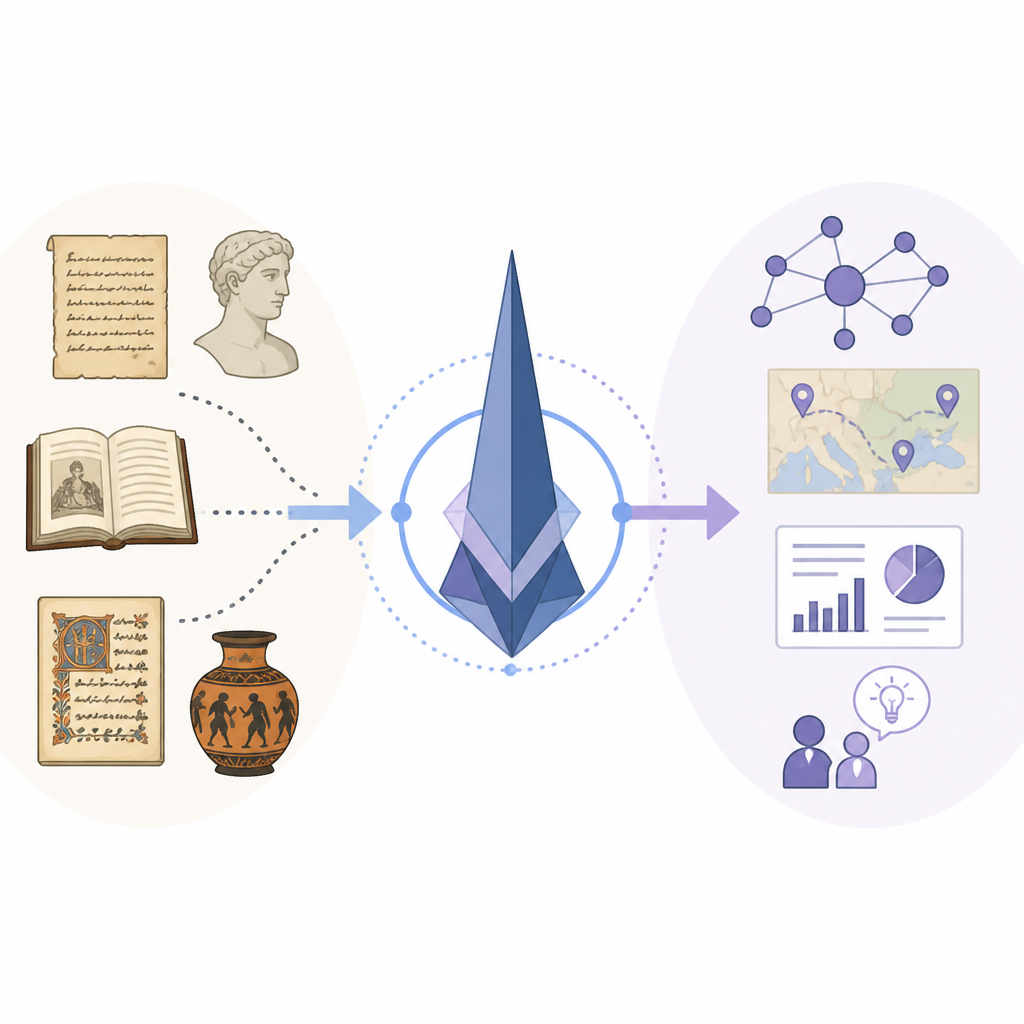
What it does say is that SPIRE recovers cited primary-source evidence more reliably than Naive LLM, Text RAG, and GraphRAG on the benchmark. It also receives higher blind-judge scores on answer accuracy, depth, coverage, and evidence quality.
That combination is important. “Recovering cited primary-source evidence” is the real technical bottleneck for evidence-grounded scholarship, while blind-judge scores tell you whether the final essays actually read like better research outputs. The paper claims improvement on both fronts.
The ablation results strengthen the argument. If removing or changing the scholarly-operation agents hurts performance, and if weakening close-reading retrieval also hurts performance, then the system’s gains are not just from a larger model or a better prompt. They come from the workflow itself.
- SPIRE outperforms Naive LLM, Text RAG, and GraphRAG on evidence recovery.
- Blind judges rate SPIRE higher on accuracy, depth, coverage, and evidence quality.
- Ablations indicate both agent orchestration and close-reading retrieval are necessary.
Why developers should care
For engineers building research assistants, this paper is a reminder that domain-specific structure matters more than generic “chat with documents” patterns. If the target users need traceable evidence, the system should be designed around evidence recovery first and prose generation second.
The paper is also a useful signal for anyone working on vertical AI in knowledge-heavy domains. A multi-agent setup may be worth the complexity when the task requires staged reasoning, source validation, and explicit citation behavior. In other words, not every problem should be solved with a single prompt and a vector database.
There is also a broader product lesson here: retrieval quality is not just about recall. In scholarship, the retrieval layer has to find the right kind of text, in the right granularity, with enough fidelity to support an argument. That is a different bar from standard enterprise search.
The fact that the authors released code, data catalogues, and reproduction scripts is another practical plus. Even without benchmark numbers in the abstract, that makes the work easier to inspect, reproduce, and adapt.
Limitations and open questions
The biggest limitation in the source material is that the abstract is short on implementation detail. It does not explain how many agents SPIRE uses, how they communicate, what retrieval model it relies on, or how the benchmark is constructed.
It also does not provide the actual benchmark numbers, so readers cannot judge effect size from the abstract alone. We know SPIRE is better than the listed baselines on the reported measures, but not by how much.
Another open question is generalization. The benchmark is focused on classical Chinese and Greco-Roman Latin scholarship, which is a strong test bed for evidence-grounded humanities work. But the abstract does not show whether the same architecture would transfer cleanly to other humanities subfields, other languages, or broader research tasks.
Even with those limits, the paper is a useful proof point: if you want AI to assist serious scholarship, you probably need more than retrieval plus generation. You need a workflow that treats evidence as a first-class object.
And that is the main engineering takeaway. The paper is not claiming that AI can replace humanities researchers. It is showing a path toward systems that can help them work with sources in a way that is more inspectable, more disciplined, and more aligned with how scholarship is actually done.
// Related Articles