SUSE and Openchip back sovereign RISC-V stack
SUSE and Openchip will tune Linux, Kubernetes and AI software for European RISC-V hardware aimed at sovereign deployments.

SUSE and Openchip are building a European RISC-V software stack for Linux, Kubernetes, and AI.
SUSE and Openchip have signed a memorandum of understanding to build what they call Europe’s first enterprise-grade sovereign stack for RISC-V hardware and open source software. The plan is to optimize SUSE Linux Enterprise Server, SUSE Rancher Prime, SUSE Kubernetes Engine (RKE2), and SUSE AI Factory for Openchip’s upcoming processors.
The timing matters. Europe is trying to reduce dependence on non-European silicon and software stacks for public sector, healthcare, defense, and other regulated environments. This deal is a software-first move toward that goal, with SUSE doing the hard work of making enterprise Linux and Kubernetes ready before the hardware ships.
| Item | Number | What it means |
|---|---|---|
| EU NextGen Funds | €111M | Backs Openchip’s industrial deployment plans |
| DARE project | €240M | Funds part of the wider European compute effort |
| Announcement date | June 25, 2026 | Marks the start of the partnership |
| Target stack | Linux, Kubernetes, AI | Shows the deal spans infrastructure layers |
What SUSE and Openchip are actually building
Get the latest AI news in your inbox
Weekly picks of model releases, tools, and deep dives — no spam, unsubscribe anytime.
No spam. Unsubscribe at any time.
The MoU is broader than a simple compatibility exercise. SUSE says it will work with Openchip on native support for RISC-V hardware, certification for enterprise use, and tuning across the stack so customers can run workloads with fewer surprises when the chips arrive.

That includes support for the RVA23 profile, RVV vector instructions for HPC and AI workloads, and hypervisor features for cloud environments. In plain English: the companies want these chips to behave like serious data center parts, not hobbyist developer boards.
- RISC-V International defines the open instruction set that Openchip is building on.
- Openchip is targeting compute accelerators for HPC and AI, not general-purpose consumer PCs.
- SUSE wants enterprise support ready before the hardware launch, which is often the part vendors skip.
- The stack includes community Linux too, with support planned for openSUSE Tumbleweed.
Why Europe cares about this now
European governments and large enterprises keep running into the same problem: the software may be open source, but the silicon underneath often is not European. That creates exposure to trade restrictions, supply chain shocks, and policy pressure that can hit critical systems at the worst possible time.
Andreas Prins, Global Head Sovereign Solutions at SUSE, framed the issue around regulation and predictability. He said, “Our enterprise customers require predictable infrastructure that complies with evolving European data regulations.” SUSE’s point is simple: if the hardware is built elsewhere, sovereignty stops at the software layer.
“Our enterprise customers require predictable infrastructure that complies with evolving European data regulations.” — Andreas Prins, Global Head Sovereign Solutions at SUSE
Robin Giller, Chief Product Officer at Openchip, made a similar argument from the hardware side. He said the chips are only half the equation and that enterprises need a reliable software ecosystem to make deployment work in the real world. That is the part many hardware launches underestimate.
For public-sector buyers, the appeal is obvious. If the stack is designed in Europe, built in Europe, and supported in Europe, procurement teams have a cleaner story for compliance audits and data residency reviews.
How this compares with the usual enterprise stack
Most enterprise infrastructure today still depends on proprietary processors and vendor-controlled platforms that were designed outside Europe. SUSE and Openchip are trying to replace that dependency with an open hardware and open software combination that still speaks the language of modern IT operations.
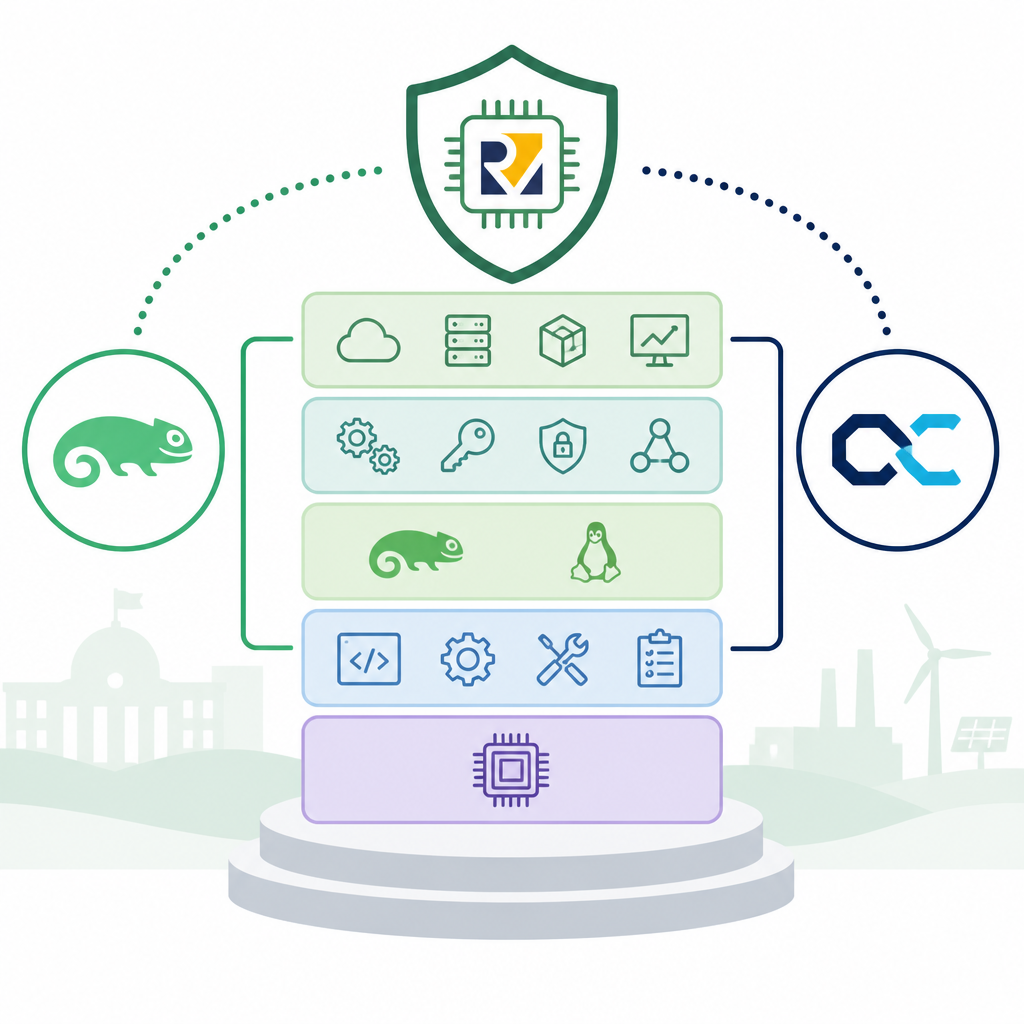
That matters because the stack is not just about the CPU. It includes container orchestration, observability, fleet management, AI inference, and the policy controls that make large deployments manageable.
- Hardware: Openchip’s RISC-V accelerators versus proprietary x86 or Arm platforms.
- Cloud-native layer: SUSE Rancher Prime and RKE2 versus generic Kubernetes distributions.
- AI layer: SUSE AI Factory versus a fragmented mix of model tools and infrastructure scripts.
- Compliance focus: NIS2, DORA, and the Cyber Resilience Act are built into the pitch from day one.
The numbers around Openchip help explain why this partnership got attention. The company was selected by the European Commission as an Important Project of Common European Interest in microelectronics, with support tied to €111 million in EU NextGen Funds and the €240 million DARE project. That is serious backing, not a speculative side project.
For SUSE, the strategic value is just as clear. The company already sells enterprise Linux, Kubernetes, edge, and AI infrastructure. Adding a European RISC-V target gives it a stronger story for customers who want to reduce dependence on foreign platforms without giving up mature tooling.
What to watch next
The big question is whether the partnership turns into products that enterprises can actually deploy, not just a policy-friendly announcement. The useful signal will be certification, benchmark results, and whether SUSE can show that RISC-V hardware handles real workloads in data centers, AI inference, and public sector environments.
If Openchip ships on schedule and SUSE delivers the promised support for Linux, Kubernetes, and AI tooling, Europe gets a more credible sovereign infrastructure option than it has had so far. If the software arrives late, the hardware story will be much harder to sell.
For now, the message is straightforward: Europe is trying to own more of the stack, from silicon to orchestration. The next milestone to watch is whether SUSE and Openchip can prove that sovereignty and enterprise performance can live in the same procurement checklist.
// Related Articles
- [IND]
AI agents are changing work in five clear ways
- [IND]
RISC-V should keep mentorships paid, limited, and public
- [IND]
SiFive raises $400M at $3.65B valuation
- [IND]
两家万亿级 IPO 把 AI 叙事讲透了
- [IND]
OpenAI’s Jalapeño chip points to faster LLM inference
- [IND]
US lets Anthropic reopen Mythos 5 to select firms