U2U and HyperSui turn Sui into a DeFi rail
I break down the U2U–HyperSui partnership and turn it into a copy-ready DeFi integration template for Sui builders.

A copy-ready playbook for wiring DeFi growth around U2U, HyperSui, and Sui.
I've been watching these Web3 partnership announcements for a while now, and most of them read like they were written by a committee trying to sound useful. This one had the same smell at first. U2U Network says it partnered with HyperSui, and the pitch is familiar: more liquidity, more users, more adoption, more everything. Fine. But when I actually read past the buzzwords, I saw a pattern I care about as a builder: one side brings distribution and infrastructure, the other brings a trading primitive, and both are trying to make Sui feel less like a chain and more like a working market.
The part that annoyed me, honestly, is how often these announcements skip the implementation details. If you are a developer, you do not need another paragraph about inclusivity. You need to know what gets connected, what gets exposed, and what you can copy into your own stack without rebuilding the whole thing from scratch. So I pulled this apart the way I would for my own team: what the partnership is really doing, why the Sui angle matters, and how to turn the idea into something operational instead of theatrical.
Source-wise, the trigger here was Crypto News’ repost of the U2U Network and HyperSui partnership, which cites U2U’s June 1, 2026 post on X. I’m treating the repost as a secondary source and the X post as the primary signal. I’m not going to invent traction numbers because the source material doesn’t give me any. What it does give me is enough structure to extract something useful.
What this partnership is actually optimizing for
Get the latest AI news in your inbox
Weekly picks of model releases, tools, and deep dives — no spam, unsubscribe anytime.
No spam. Unsubscribe at any time.
“As the first Perp DEX built on Sui, HyperSui is bringing fast, low-cost, and user-friendly DeFi trading to the next generation of Web3 users.”
What this actually means is simple: HyperSui wants to be the trading surface, and U2U wants to be the distribution and infrastructure layer that makes that surface easier to reach. That’s the real story. Not “partnership,” not “ecosystem synergy,” just a practical attempt to combine a venue with a network.

I’ve seen a lot of teams make the mistake of thinking a DeFi product wins by being technically clever alone. It doesn’t. If users can’t find it, trust it, or get to it without friction, the product dies quietly. A perp DEX on Sui has a decent pitch already: faster settlement, lower fees, and a chain that can support active trading behavior better than many congested alternatives. But a DEX still needs a path to users. That’s where a network partner like U2U matters.
There’s a useful distinction here between product value and access value. HyperSui is trying to own product value by being a trading venue. U2U is trying to own access value by providing reach, infrastructure, and whatever ecosystem gravity it can create. If those two are aligned, the result is not just “more marketing.” It can actually reduce the number of steps between a user hearing about a trading opportunity and opening a position.
How to apply it: if you’re building on Sui or any other chain, stop asking whether your partner adds “credibility.” Ask whether they shorten the path from discovery to transaction. If they don’t improve that path, the partnership is mostly decorative.
- Map the user journey from first touch to first trade.
- Identify which partner owns discovery, onboarding, execution, and retention.
- Write down the one step each partner removes.
That’s the first filter I use now. If a partnership doesn’t remove at least one real user step, I treat it as branding with a press release attached.
Sui is the point, not the backdrop
The article keeps circling back to Sui, and that’s not accidental. The chain is not just the host environment here. It’s the reason the pitch can sound credible at all. Sui’s object-centric design and parallel execution model are exactly the kinds of details teams point to when they want to argue that a trading app can feel faster and less painful than the usual on-chain mess.
That matters because perp trading is extremely sensitive to latency, slippage, and UX. If you’re building a derivatives product, every tiny delay feels bigger than it should. I’ve worked around enough trading flows to know the user doesn’t care how elegant your architecture slide is. They care whether the quote updates in time and whether they get wrecked by the interface.
The partnership text says the collaboration aims to accelerate the DeFi ecosystem through the Sui network. That’s a broad phrase, but the practical interpretation is cleaner: Sui is being used as the substrate for a trading experience that claims to be fast, low-cost, and user-friendly. That combination is exactly what perp DEX teams need if they want to compete with centralized exchanges on anything other than ideology.
If you want the technical version of this lesson, look at the official Sui docs and ecosystem material from Sui. Then compare that to the actual behavior users expect from a perp DEX. The gap between those two things is where product work lives. Not in slogans. In flow design, wallet friction, execution reliability, and liquidity routing.
How to apply it: when you pick a chain for a trading product, don’t start with “which chain is popular.” Start with “which chain lets me make the user feel fast.” That’s a very different question.
- Benchmark wallet connection time.
- Benchmark first trade completion time.
- Benchmark how many clicks it takes to reach the position screen.
If your chain choice doesn’t improve those numbers, you’re probably using the wrong chain for the job.
U2U is selling distribution, not just infrastructure
The article describes U2U Network as a Web3 infrastructure platform, but the more interesting phrase is the one about “scalable community reach.” That’s the giveaway. Infrastructure alone is easy to commoditize. Distribution is harder. Community reach is even harder because it implies an existing audience that can be pointed toward a product without starting from zero.
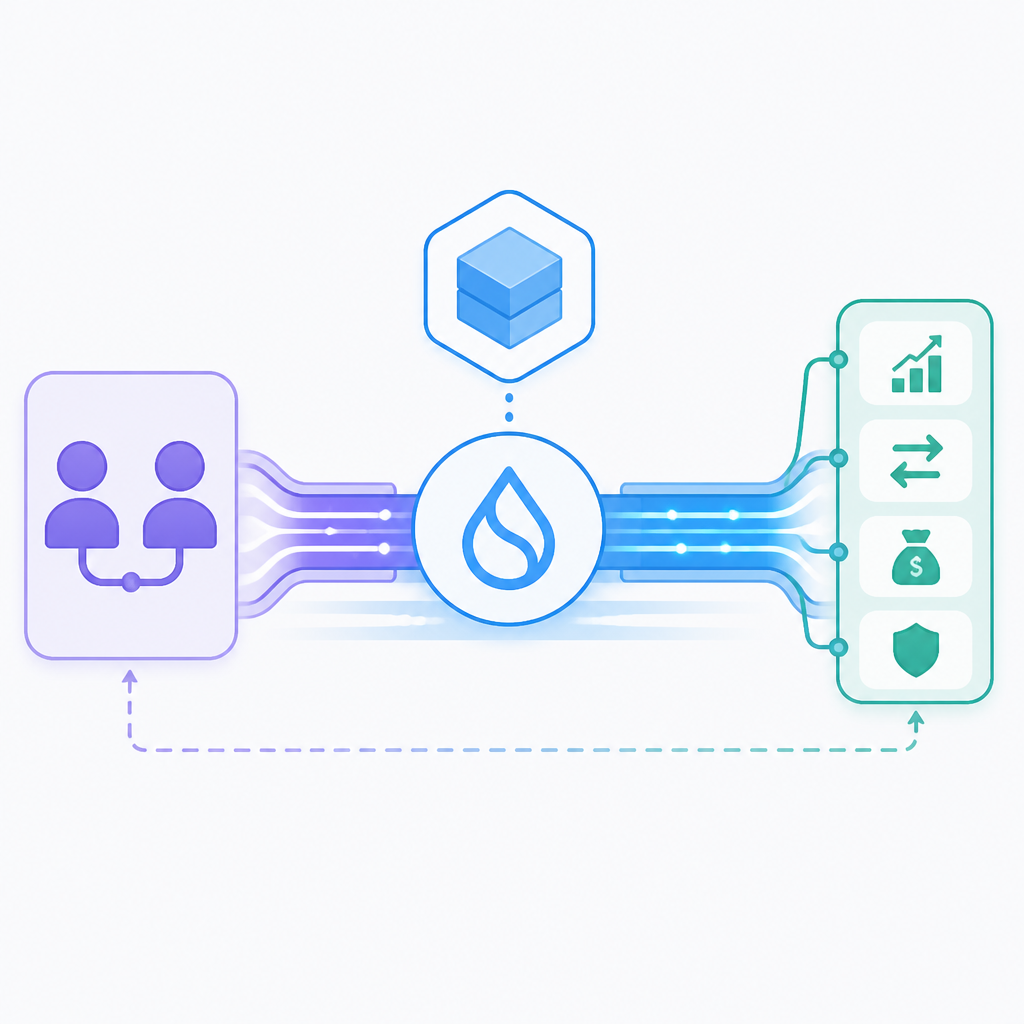
I think this is where a lot of readers misread partnership announcements. They assume “infrastructure” means nodes, tooling, and technical primitives. Sometimes it does. But in practice, infrastructure partners often become the social and operational layer that helps a product move. They can provide developer attention, ecosystem introductions, and the kind of repeated visibility that turns a niche app into something people actually try.
The article also says U2U’s support goes beyond technical integration and includes developer resources, outreach, and education initiatives. That’s the part I’d pay attention to if I were building on top of this. Education and outreach are boring words until you realize they’re how you fill a funnel without buying every click.
I ran into this exact problem once while helping a team launch a DeFi dashboard. The code was fine. The docs were okay. The problem was that nobody outside the core group understood why they should care. The fix wasn’t a new contract. It was a better explanation path, a few ecosystem partners, and a repeatable onboarding story. That is what U2U seems to be offering here, whether the press release says it plainly or not.
How to apply it: if you’re the infrastructure side of a partnership, don’t just hand over APIs and call it support. Build the distribution kit.
- One-page integration guide
- Launch checklist for partner teams
- Community announcement kit
- Developer office-hours cadence
That’s the difference between “we partnered” and “we can actually ship together.”
Liquidity is the real product hiding under the pitch
The article talks a lot about liquidity expansion, and that’s where the whole thing gets real. In DeFi, liquidity is not some abstract metric you mention to sound sophisticated. It is the product. Without it, your exchange is a demo. With it, your exchange becomes something traders can trust enough to use more than once.
HyperSui, as a perp DEX, lives or dies on market depth and execution quality. The article says the partnership gives HyperSui access to a resilient network that backs liquidity expansion, community-powered growth, and developer engagement. That sounds like marketing copy, but the underlying idea is valid. A trading venue needs a place to gather users, market makers, and builders. U2U is being positioned as that place.
I’ve seen teams obsess over UI polish while ignoring liquidity bootstrapping. That’s backwards. A clean interface with no depth is just a prettier way to fail. The hard part is getting enough activity to make the market feel alive. Once that happens, the UI matters more, but not before.
If you’re building a perp DEX or any trading product, think in layers:
First, you need market makers or liquidity sources. Second, you need user acquisition. Third, you need retention mechanisms that keep activity flowing. A partnership like this is trying to help with all three, but especially the second and third layers. That’s why it matters.
How to apply it: write a liquidity plan before you write a launch tweet.
- Where does initial depth come from?
- Who seeds the first trading pairs or markets?
- How do you keep spreads tight after the first week?
Those questions are uncomfortable, which is usually how you know they matter.
Interoperability is the part everyone says and nobody ships well
The article mentions interoperability across chains, and I’m always skeptical when I see that phrase. Not because it’s false, but because it’s usually hand-waved. Interoperability is where every team discovers that connecting systems is easy in a slide deck and annoying in production.
Still, the claim makes sense in this context. If U2U wants to broaden access and HyperSui wants to expand trading opportunities, then cross-chain reach is not optional. Traders don’t live in one ecosystem forever. Liquidity moves. Attention moves. Users chase incentives and better execution. If your product can’t meet them where they are, you lose them.
This is where the partnership could become more than a local Sui story. If U2U can help HyperSui expose parts of its experience to broader Web3 audiences, and if HyperSui can give U2U a concrete trading product to point at, then both sides get something useful. But again, that only works if the integration is real.
My rule here is boring but effective: if you can’t explain the interoperability path in one paragraph without using the words “ecosystem” or “synergy,” you probably don’t understand it well enough yet.
How to apply it: define interoperability in terms of user behavior, not architecture diagrams.
- Can a user get from one chain context to another without confusion?
- Can assets move without manual babysitting?
- Can the product preserve trust through the transition?
If the answer is no, your interoperability story is still aspirational, not operational.
The real takeaway: partnerships should reduce friction, not add ceremony
Here’s my blunt read. This partnership is interesting because it tries to combine a chain-native trading venue with an ecosystem layer that can help it grow. That is a normal pattern, but it’s still useful when it’s done with actual intent. The article’s strongest signal is not the generic language about adoption. It’s the repeated emphasis on accessibility, developer support, liquidity, and user-friendly trading.
That combination tells me the teams are aiming at the right problem, even if the wording is a little overcooked. DeFi doesn’t need more ceremonial partnerships. It needs fewer dead ends. It needs products that are easy to discover, easy to trust, and easy to use once people arrive. If U2U and HyperSui can make Sui feel like a place where trading actually happens, then the partnership has a point.
For builders, the lesson is sharper than the announcement. Don’t evaluate a partnership by how nice it sounds. Evaluate it by how much friction it removes from a real user flow. If it doesn’t reduce friction, don’t pretend it’s strategy. It’s just decoration.
If you want to sanity-check this against primary sources, start with the original U2U post on X at @u2u_xyz, then compare it with the repost on Crypto News and the Sui ecosystem context at sui.io. That’s enough to see where the claim is coming from and where the editorial gloss begins.
The template you can copy
# DeFi partnership launch template for a chain-native app

## One-line positioning
[Partner A] and [Partner B] are working together to reduce friction in [specific user flow] on [chain/ecosystem].

## What each partner contributes
- Partner A: distribution, community reach, developer support, or infrastructure
- Partner B: product, trading venue, liquidity source, or user-facing app
- Shared goal: reduce steps between discovery and first transaction

## Why this matters
- Users get [faster onboarding / lower fees / better execution / easier access]
- Builders get [better tooling / more visibility / more integrations]
- The ecosystem gets [more activity / deeper liquidity / stronger retention]

## Implementation checklist
1. Define the exact user flow this partnership improves.
2. List the technical integration points.
3. List the growth or distribution assets each side provides.
4. Identify the liquidity source or market-making plan.
5. Publish the onboarding path for users and builders.
6. Set one measurable outcome for the first 30 days.

## Copy-ready announcement draft
[Partner A] has partnered with [Partner B] to improve [specific outcome] on [chain].

This collaboration combines [Partner A’s strength] with [Partner B’s strength] to make [user action] faster, easier, and more accessible.

For users, that means:
- [benefit 1]
- [benefit 2]
- [benefit 3]

For builders, that means:
- [tooling or integration benefit 1]
- [tooling or integration benefit 2]
- [tooling or integration benefit 3]

The partnership will focus on:
- [integration work]
- [community or developer activation]
- [liquidity or product rollout]

## Internal launch checklist
- [ ] Primary source confirmed
- [ ] Chain context verified
- [ ] User flow documented
- [ ] Integration owner assigned
- [ ] Liquidity plan written
- [ ] Support and docs published
- [ ] First metric defined

## Metrics to track
- Wallet connections
- First trade completions
- Liquidity depth
- Retention after 7 days
- Developer integrations started

## Short version for docs
This partnership exists to reduce friction between discovery, onboarding, and execution for users building or trading on [chain].
That template is the part I’d actually keep around. It strips the announcement down to the bits that matter: who contributes what, what user friction gets removed, and what gets measured after launch. Everything else is decoration.
The original source is the Crypto News repost at https://cryptonews.net/news/defi/32950361/, which points back to U2U Network’s June 1, 2026 X post. My breakdown is original commentary and structure built from that source, not a claim of exclusive reporting.
// Related Articles
- [IND]
Anthropic's IPO rumor turns into a market watch
- [IND]
Anthropic should not become dependent on Meta for compute
- [IND]
Mistral's robotics model cuts indoor navigation costs
- [IND]
Mistral missile: France’s short-range air defense workhorse
- [IND]
Apple Reclaims No. 1 by Market Cap as AI Costs Spike
- [IND]
Kimi K3 could pressure the middle tier of AI models