Vibe coding is changing enterprise software work
CIOs at Snowflake and Clover are using vibe coding to speed software delivery while tightening governance and change management.

Vibe coding is moving from hobbyist demos into enterprise software delivery.
At Snowflake and Fiserv's Clover, leaders say the real work is not generating code, but changing how teams build, review, and trust it. The shift is already showing up in sprint cadence, governance rules, and the way CIOs measure adoption.
| Metric | Value | What it means |
|---|---|---|
| Enterprises studied | 150 | Scale of the productivity data cited |
| Routine coding time reduction | 46% | Reported gain from AI-assisted work |
| Snowflake sprint cadence | 1 week | Down from a 3-week cycle |
| Clover change window | Half day | Down from 2 to 3 weeks |
| Blandina demo build | 5 Sundays | Time he spent building a full system with AI tools |
| Clover merchant base | About 1 million | Size of the platform’s merchant footprint |
| Countries served | 12 | Geographic reach of Clover |
Why vibe coding is getting real inside enterprises
Get the latest AI news in your inbox
Weekly picks of model releases, tools, and deep dives — no spam, unsubscribe anytime.
No spam. Unsubscribe at any time.
The phrase “vibe coding” still sounds casual, but the behavior behind it is serious: developers describe intent in natural language and let AI produce working code. That changes the bottleneck. The hard part stops being typing syntax and starts being deciding what belongs in the system, what gets approved, and what gets blocked.

SiliconANGLE’s coverage from Snowflake Summit 2026 puts that tension in plain view. The productivity upside is obvious enough that teams are experimenting quickly, but the organizational friction is just as obvious once AI-generated code reaches regulated environments.
Mike Blandina, chief information officer of Snowflake, framed the issue as one of guardrails. His point was simple: teams can define standards inside the model and enforce them through the software development lifecycle, the same way they would with any other engineering process.
- AI-assisted coding can compress routine work, but it also shifts attention to policy, review, and accountability.
- Teams that adopt it quickly still need artifact standards, approval rules, and clear project boundaries.
- The biggest resistance often comes from people who have worked the same way for years, not from the tooling itself.
Change management is the real product
Blandina’s comments matter because they cut through the usual AI hype. The story here is not that code gets generated faster. It is that leaders now have to manage human behavior around a new production model.
He described moving his team from a three-week sprint cycle to a one-week cadence to make the speed difference impossible to ignore. That kind of forced compression is a classic change-management move: if the team can see delivery happen faster, the abstract promise of AI becomes harder to dismiss.
He also said he built a full working system himself over five Sundays, including 60 entities, a complete React front end, and batch processes. That demo was less about showing off and more about credibility. If a CIO can build something real with AI tools, the rest of the organization has a harder time treating the workflow as a toy.
“I think you can enforce standards in the model,” Blandina said. “In this particular project, anything we build, here’s a set of boundaries that you, as my agent for code development, should not cross.”
That quote gets to the heart of enterprise vibe coding. The model is not a free-for-all. It is a constrained contributor inside an existing control system. For regulated companies, that distinction is the difference between experimentation and adoption.
At Clover, senior vice president, global chief information officer and chief technology officer Vinayak Kagalkar described a similar pattern. The company operates in financial services, where compliance is part of everyday engineering, so the team is applying the same controls to AI-generated code that it already uses for traditional development.
What the numbers say about adoption
The most useful data point in this story is the one that ties productivity to behavior change. A February 2026 compilation of statistics from GitHub, McKinsey, Stack Overflow, Gartner, and company disclosures found a 46% reduction in time spent on routine coding tasks across 150 enterprises. That is a big enough number to change budgets, staffing plans, and expectations.
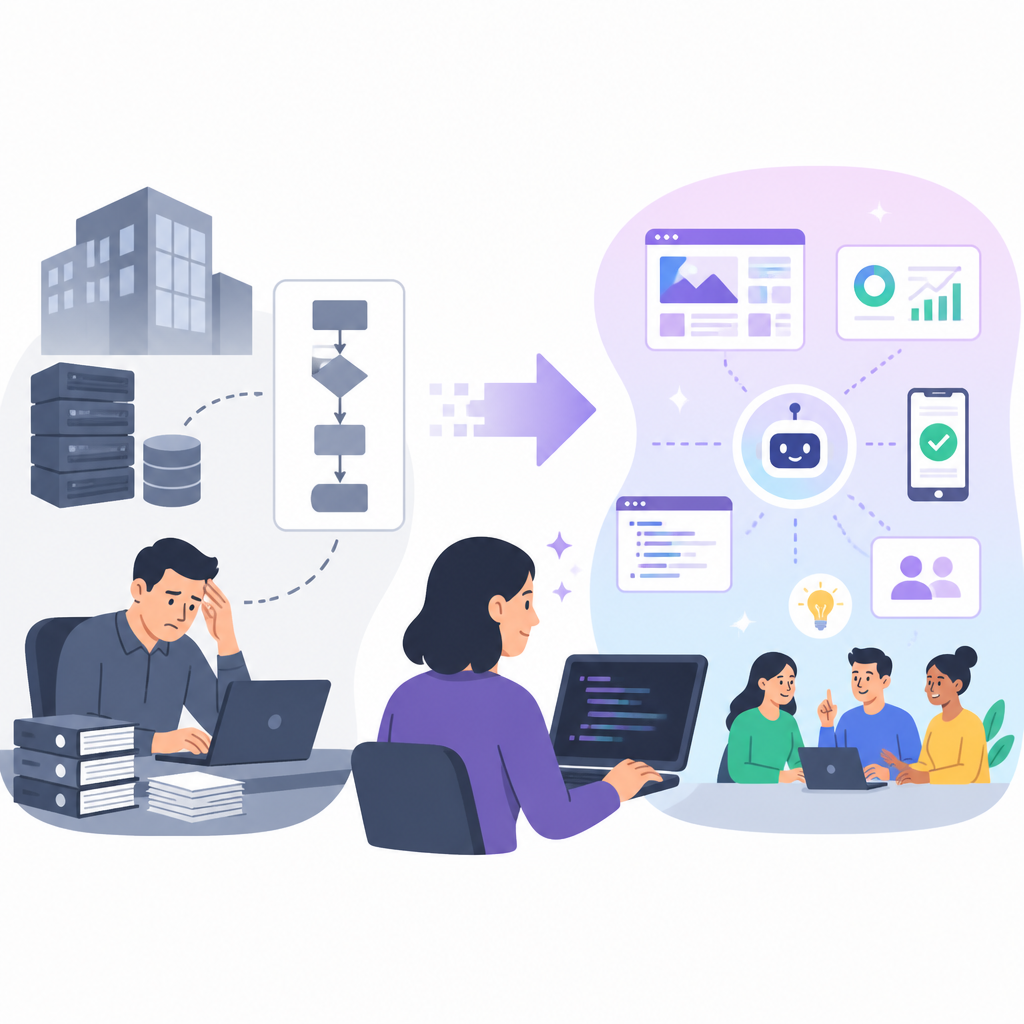
Still, Kagalkar’s comments show why raw productivity data does not tell the full story. If a simple change used to take two to three weeks and now takes half a day, the organization has to rethink review cycles, release planning, and how much work a sprint can hold. Speed changes the shape of the process around it.
- Snowflake moved from a 3-week sprint cadence to a 1-week cadence.
- Clover says simple changes can move from 2 to 3 weeks to about half a day.
- The productivity study covered 150 enterprises, which gives the 46% figure more weight than a single-company anecdote.
- Blandina’s five-Sunday demo shows how leadership can use hands-on proof to reduce skepticism.
The enterprise lesson is pretty clear: AI coding tools do not remove process, they expose it. If your review system is slow, AI makes that obvious faster. If your standards are vague, AI will amplify the confusion. If your teams already trust their controls, AI can move through the organization much more quickly.
What CIOs should take from Snowflake and Clover
This is where the article stops being about a trend and becomes a practical playbook. The companies that are making progress are treating vibe coding as a management change, not a tooling rollout. They are setting boundaries in the model, tightening sprint timing, and making adoption visible to the people who might resist it.
That approach will probably define the next phase of enterprise software work. The winners will not be the teams that generate the most code. They will be the teams that can prove the code is safe, useful, and easy to govern at speed. The open question for CIOs is simple: if AI can write a feature in hours, can your organization approve, test, and ship it just as fast?
Related reading: AI agent web traffic has surpassed human traffic.
// Related Articles
- [IND]
WAIC 2026 turns AI hype into real work
- [IND]
KPMG’s OpenAI deal turns SaaS into agents
- [IND]
Trump adviser accuses Moonshot AI of stealing Anthropic
- [IND]
Vector databases will reshape financial search, not replace core syst…
- [IND]
Milvus 3.0 adds lake-native vector search
- [IND]
Google’s Q2 2026 results prove AI spend is now the story