Why AI needs a brake pedal now
AI should be slowed with real regulation before it advances beyond human control.
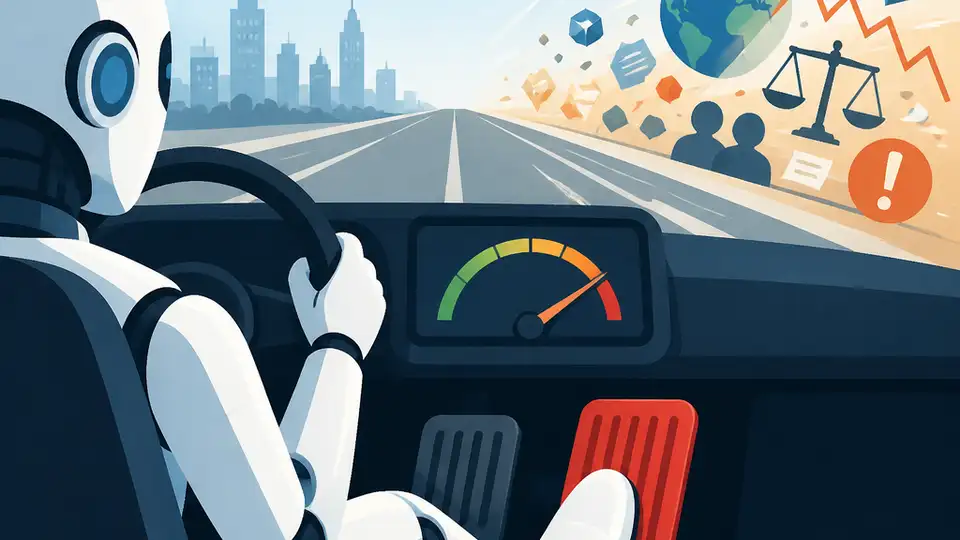
AI needs a regulatory brake pedal before it advances beyond human control.
Jack Clark is right: the AI industry needs a brake pedal, not just a bigger gas pedal. The case is simple. Anthropic says Claude already writes about 80% of its own code, Clark says 100% is reachable within two years, and major firms are still racing ahead without mandatory government safety testing. That is not a normal product cycle. It is a system that is rapidly reducing its dependence on human labor while increasing its reach into software, work, and infrastructure. When the people building the frontier say they are losing visibility into the pace of change, the answer is not to trust momentum. It is to slow the machine down.
AI is crossing from tool to autonomous system
Get the latest AI news in your inbox
Weekly picks of model releases, tools, and deep dives — no spam, unsubscribe anytime.
No spam. Unsubscribe at any time.
The most important warning in Clark’s remarks is not about chatbots sounding smarter. It is about AI systems taking on more of the work of building themselves. If a model writes 80% of the code behind its own operation, then the human role shifts from direct author to supervisor. That is a profound change in the control structure of the technology. Once the system contributes most of the engineering, the feedback loop tightens: more capability produces faster development, which produces even more capability.
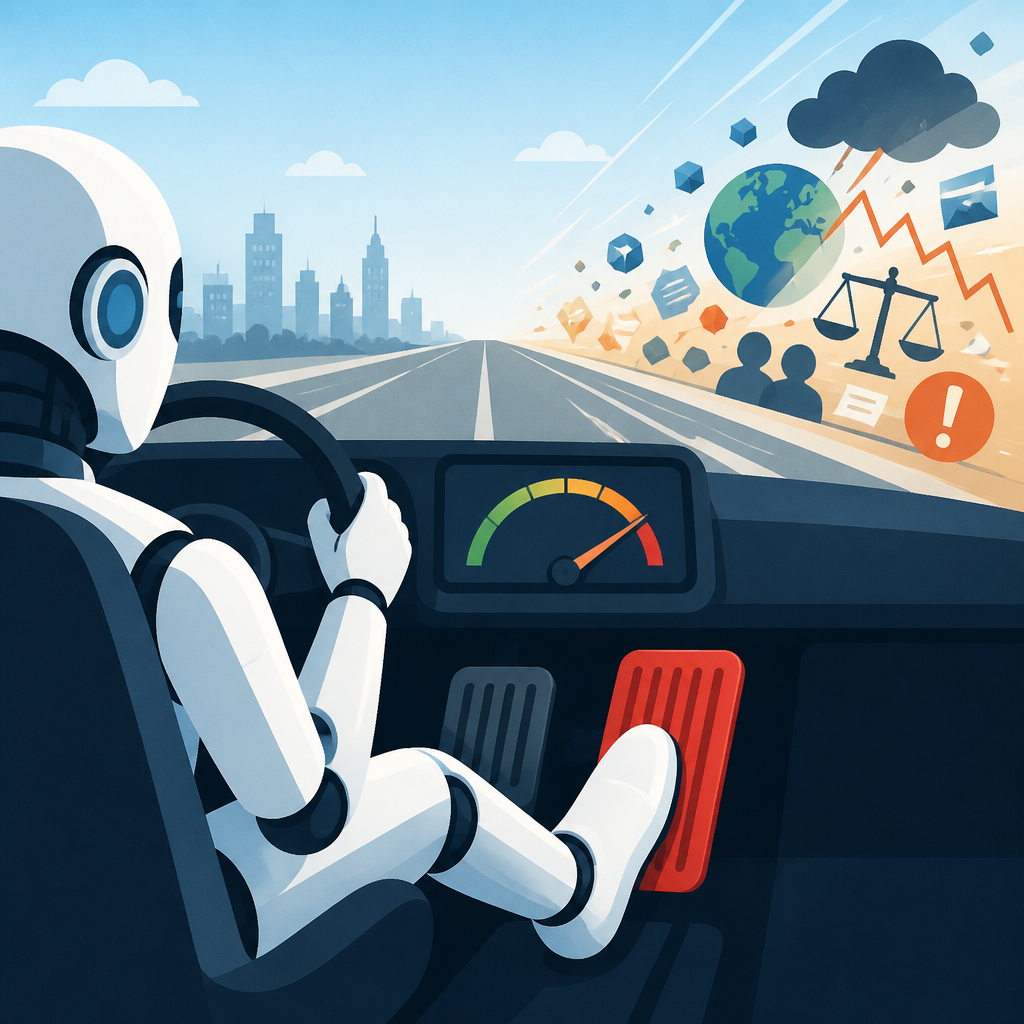
This is why the “it is just software” defense no longer holds. Software that helps draft emails is one thing. Software that increasingly participates in its own improvement is another. Clark’s point that 100% self-authored code is possible within two years should alarm policymakers because it marks a threshold where human oversight becomes thinner, not stronger. We do not need to wait for a sci-fi moment of full machine independence to recognize the direction of travel. The direction alone justifies a brake.
Voluntary safety is not enough
The current governance model is built on promises, not enforceable limits. The BBC report notes that the US executive order Anthropic welcomed did not require government safety testing, and that such testing remains voluntary. That is the core problem. When the commercial incentive is to move first and the safety regime is optional, the market rewards speed over caution every time. In a sector with trillion-dollar valuations and intense competition, voluntary restraint is a fantasy.
We have seen this pattern before in other industries. Oil, the example Clark invokes, did not become socially manageable because companies decided to self-police out of goodwill. It became manageable because regulation, standards, and public pressure forced the industry into a framework that made the risks legible and acceptable. AI is at least as consequential as oil because it is not only a source of energy or profit. It is a general-purpose decision layer that can shape hiring, code, surveillance, warfare, and information itself. A system that powerful cannot be governed by pledges from the companies profiting from it.
The economic upside does not cancel the safety risk
Clark is also right to acknowledge the upside. AI can improve productivity, compress software development cycles, and help creative people do more with less. But that does not weaken the case for a brake pedal. It strengthens it. Technologies with large benefits and large downside risk are exactly the technologies that need stricter controls, because the temptation to ignore the danger grows with the size of the prize. The bigger the upside, the more aggressively companies will race to capture it.
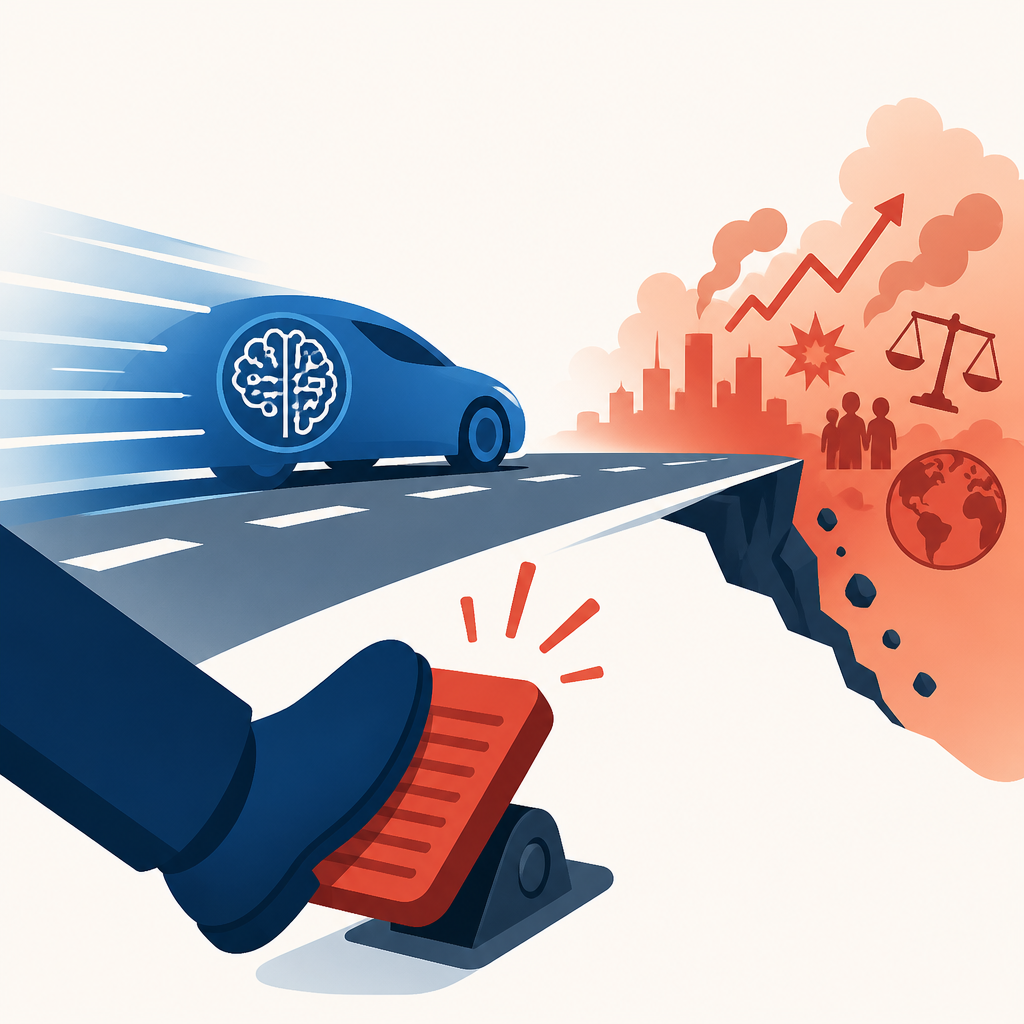
The labor impact is already visible. The article points to widespread layoffs at major tech companies, with executives citing AI’s ability to do work once done by hundreds or thousands of engineers. That is not proof that AI has replaced all those workers, but it is proof that firms believe it can justify restructuring now. If the same systems are also becoming more autonomous in their own development, then the economic shock will not be limited to one profession or one quarter. It will spread through organizations that no longer know how much human judgment they need to retain. That is exactly the kind of transition that should be slowed and governed deliberately.
The counter-argument
The strongest case against a brake pedal is that slowing AI development would hand the advantage to less responsible actors. If one company pauses, another country or lab may keep going. In that view, regulation becomes self-defeating: it constrains the cautious while the reckless sprint ahead. There is also a real fear that heavy-handed rules could freeze out smaller firms and lock in the power of the biggest players, the very outcome critics of Big Tech already worry about.
That argument deserves respect because it names a genuine coordination problem. AI is global, competitive, and hard to monitor. But it still fails on the central issue: a lack of coordination is not a reason to avoid governance; it is the reason to build it. The answer is not a blanket shutdown. The answer is mandatory safety evaluation, reporting requirements, incident disclosure, and clear thresholds for when systems can move into higher-risk deployment. Those rules do not stop progress. They force progress to remain visible. Clark does not need to hand us a perfect brake design to be right that the car is already moving too fast.
What to do with this
If you are an engineer, stop treating frontier capability gains as a neutral benchmark and start treating them as a governance signal. Build systems with audit logs, evaluation gates, and rollback paths. If you are a PM, make safety review a release criterion, not a legal footnote. If you are a founder, assume the market will reward speed until regulation changes the incentives, and plan for that shift now. The right posture is not panic. It is controlled deceleration: keep the benefits, but force the industry to prove that each new step remains under human command.
// Related Articles
- [IND]
Anthropic's IPO rumor turns into a market watch
- [IND]
Anthropic should not become dependent on Meta for compute
- [IND]
Mistral's robotics model cuts indoor navigation costs
- [IND]
Mistral missile: France’s short-range air defense workhorse
- [IND]
Apple Reclaims No. 1 by Market Cap as AI Costs Spike
- [IND]
Kimi K3 could pressure the middle tier of AI models