Why GPU financing is the real AI moat
GPU financing, not raw GPU access, is becoming the decisive moat in AI infrastructure.

GPU financing, not raw GPU access, is becoming the decisive moat in AI infrastructure.
IREN’s $3.65 billion GPU financing tied to its Microsoft AI contract shows the market’s real bottleneck: not demand for compute, but the ability to fund it. When customer prepayments are added in, the facility covers $5.59 billion of the contract’s $5.81 billion in GPU capital expenditures, or about 96% of the total. That is not a side note. It is the point. The companies that can warehouse capital, structure debt, and convert long-term demand into bankable cash flows will win the AI buildout long before the companies that merely talk about having access to chips.
Capital structure is now part of the product
Get the latest AI news in your inbox
Weekly picks of model releases, tools, and deep dives — no spam, unsubscribe anytime.
No spam. Unsubscribe at any time.
AI infrastructure used to be judged on location, power, and hardware procurement. That is outdated. The IREN-Microsoft deal shows that financing has become embedded in the supply of compute itself. If nearly the entire GPU bill can be financed upfront through a mix of facility debt and customer prepayments, then the provider is not just selling servers. It is selling a capital structure that lets a hyperscaler lock in capacity without bearing the full balance-sheet hit on day one.

That matters because GPU clusters are not cheap experiments. They are massive, front-loaded bets with long payback periods and fast-moving technology risk. A provider that can raise billions against contracted demand has a structural advantage over one that must fund expansion from retained earnings or expensive equity. In practice, that means the winners are increasingly the firms that can turn future usage into present-day financing. The hardware still matters, but the financing now determines who can scale fast enough to matter.
Contracted demand is worth more than idle capacity
The financing only works because Microsoft is not a speculative customer. It is a creditworthy buyer with a real need for compute, and that changes everything. Lenders do not fund $3.65 billion of GPU buildout because they admire ambition. They fund it because the contract reduces uncertainty. Contracted demand transforms GPUs from volatile inventory into financeable infrastructure, much like a power plant backed by a long-term offtake agreement.
That is the bigger story for the market. The AI boom is entering a phase where the scarce asset is no longer just the chip supply chain. It is bankable demand. A company that can sign a large, durable customer contract and then use that contract to unlock external capital has a compounding advantage. It can build more, sooner, and with less dilution. Competitors without that kind of demand quality face a harsher reality: they can buy GPUs, but they cannot finance them cheaply, and in this business cheap capital is the difference between growth and irrelevance.
The balance sheet is becoming a competitive weapon
IREN’s deal also exposes a harder truth about AI infrastructure: scale is now a financial engineering problem as much as an engineering problem. The providers that survive will be the ones that can combine project finance, customer prepayments, and asset-backed lending into a repeatable machine. This is not theoretical. The numbers in the Microsoft contract show a system where most of the GPU capex is already spoken for before the hardware is fully deployed. That reduces execution risk and makes each new expansion easier to finance.
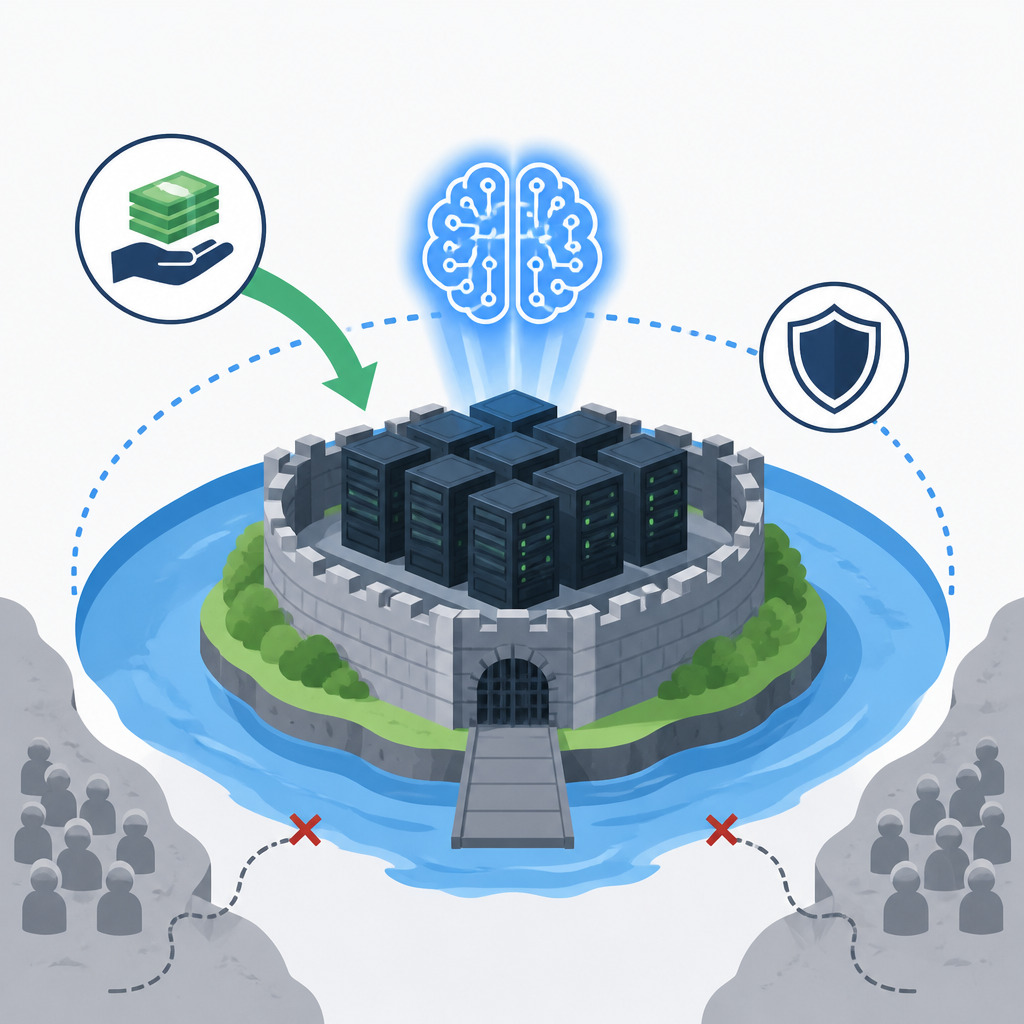
Look at the broader implication for the sector. The market often talks about “GPU shortages” as if the issue is supply alone. But the real constraint is who can afford to buy, deploy, and carry those GPUs at scale while waiting for revenue to catch up. A strong balance sheet is no longer just a defensive asset. It is a growth engine. Firms that can borrow against contracted AI demand will outbuild firms that rely on spot-market optimism. Over time, that creates a winner-take-most dynamic where access to capital becomes as important as access to silicon.
The counter-argument
Supporters of the current AI infrastructure rush argue that this is simply prudent finance. If a customer like Microsoft is willing to commit to capacity, then it makes sense to use debt and prepayments to match costs with revenue. They are right about one thing: this is cleaner than speculative buildout. It lowers the chance of stranded assets and aligns funding with demand. It also lets providers expand faster than they could from internal cash flow alone, which is essential in a market where delays mean lost share.
But that defense misses the strategic risk. Financing is not a substitute for differentiation. It is a force multiplier for whoever already has demand, credibility, and execution. If the market normalizes huge GPU facilities funded by debt and prepayments, the likely outcome is not broad competition. It is concentration. The companies with the best customers and the strongest capital access will keep compounding, while everyone else gets squeezed into worse financing terms or smaller, less competitive deployments.
I accept the prudence argument, but it does not weaken my position. It strengthens it. The point is not that financing is reckless. The point is that financing has become the moat. In AI infrastructure, the ability to secure cheap capital against contracted demand is now one of the clearest predictors of who scales and who stalls.
What to do with this
If you are an engineer, PM, or founder building in AI infrastructure, stop treating procurement as a back-office concern. Design for financeability from the start. Build around contracted demand, repeatable deployment units, clear asset lifecycles, and customers that can support prepayments or long-term commitments. If you are raising capital, learn to speak the language of project finance, not just product vision. In this market, the best technical roadmap loses to the better-funded one, and the better-funded one is usually the one that can prove its cash flows before it ships the hardware.
// Related Articles
- [IND]
Anthropic's IPO rumor turns into a market watch
- [IND]
Anthropic should not become dependent on Meta for compute
- [IND]
Mistral's robotics model cuts indoor navigation costs
- [IND]
Mistral missile: France’s short-range air defense workhorse
- [IND]
Apple Reclaims No. 1 by Market Cap as AI Costs Spike
- [IND]
Kimi K3 could pressure the middle tier of AI models