SpeechParaling-Bench tests speech models on nuance
A new benchmark expands paralinguistic speech evaluation past coarse labels, using 1,000+ queries and pairwise judging to expose model gaps.

Most speech models are still weak at the stuff humans notice immediately: tone, emphasis, mood, and other paralinguistic cues. SpeechParaling-Bench: A Comprehensive Benchmark for Paralinguistic-Aware Speech Generation is built to measure that gap more directly, and it does so in a way that tries to reduce the usual subjectivity of speech evaluation.
For engineers building large audio-language models, voice assistants, or speech generation systems, this paper matters because it shifts the question from “can the model speak?” to “can it speak with the right nuance, in the right context, and do so consistently?”
What problem this paper is trying to fix
The paper starts from a simple but important limitation: paralinguistic cues are essential for natural human-computer interaction, but they are not well covered by existing evaluation setups. Current assessments of large audio-language models tend to rely on coarse features, which makes it hard to tell whether a model is actually good at controlling subtle speaking style or just passing broad checks.

That problem gets worse because judging paralinguistic quality is inherently subjective. Two responses can both be “acceptable” on paper, while one clearly sounds more natural, more context-aware, or more emotionally aligned to a listener. If you are trying to compare models or track progress, that kind of fuzziness makes the benchmark less useful.
SpeechParaling-Bench is presented as a response to both issues at once: it broadens the feature space being tested and introduces a comparison method that avoids relying on absolute scores alone.
How the benchmark works in plain English
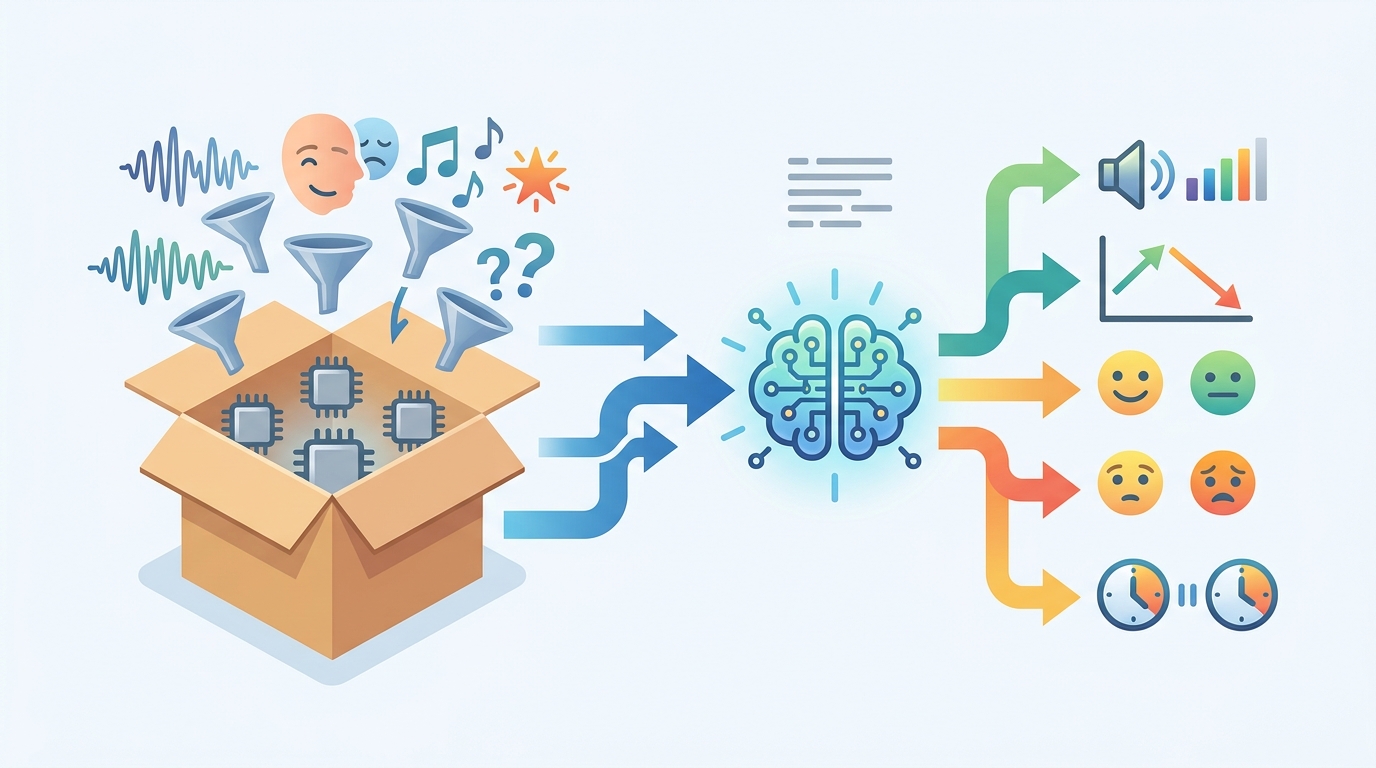
The benchmark expands coverage from fewer than 50 features to more than 100 fine-grained paralinguistic features. That is the core idea: instead of treating speech style as a small set of broad categories, it breaks the task into more specific dimensions that better reflect how humans actually speak.
It also includes more than 1,000 English-Chinese parallel speech queries. That matters because it gives the benchmark a bilingual shape and makes it easier to test whether a model can handle paralinguistic behavior across languages rather than only in one setting.
The benchmark is organized into three tasks that get progressively harder:
- Fine-grained control — can the model directly produce a requested paralinguistic feature?
- Intra-utterance variation — can it vary features within a single utterance instead of sounding flat or uniform?
- Context-aware adaptation — can it adjust its delivery based on the surrounding situation?
That structure is useful because it separates static control from dynamic behavior. A model that can imitate a style label is not necessarily able to modulate that style over the course of a sentence, or adapt when dialogue context changes.
The paper also introduces a pairwise comparison pipeline for evaluation. Instead of assigning an absolute score, candidate responses are judged against a fixed baseline using an LALM-based judge. In practical terms, the benchmark asks which output is better relative to a reference point, rather than forcing a single numeric rating that may vary from rater to rater.
Why pairwise judging matters
This design choice is one of the more practical parts of the paper. Absolute scoring is convenient, but for subjective qualities like voice nuance it can be unstable. Pairwise preference is often easier to apply consistently because the judge only has to decide which of two outputs is better under the same conditions.
According to the paper, framing evaluation as relative preference helps mitigate subjectivity and makes assessments more stable and scalable without costly human annotation. That does not mean the evaluation becomes perfect, but it does mean the benchmark tries to reduce one of the main bottlenecks in speech evaluation: getting reliable labels at scale.
Using an LALM-based judge is also a sign of where the field is heading. When the target behavior is nuanced speech generation, the evaluation stack itself starts to look like an AI-assisted system rather than a purely manual scoring process.
What the paper actually shows
The paper reports extensive experiments, and the headline result is blunt: current LALMs still have substantial limitations in paralinguistic speech generation. Even leading proprietary models struggle with comprehensive static control and dynamic modulation of paralinguistic features.
That is an important result because it suggests the problem is not just a lack of training data or a weak open model baseline. The paper’s evaluation implies that the field still has a long way to go on both precise control and context-sensitive adaptation.
One concrete number stands out: failure to correctly interpret paralinguistic cues accounts for 43.3% of errors in situational dialogue. That makes the issue feel less like a niche quality problem and more like a major source of real interaction failure.
The abstract does not provide benchmark scores, model-by-model rankings, or full numerical breakdowns beyond that error share, so those details are not available here. What the source does make clear is that the benchmark exposes meaningful weaknesses in current systems rather than simply confirming that they work.
What developers should take away
If you are building speech interfaces, this paper is a reminder that “correct text” is not enough. A voice assistant can produce the right words and still fail if it sounds flat, mismatched to context, or unable to express the intended paralinguistic signal.
For teams working on LALMs or speech generation pipelines, SpeechParaling-Bench offers a more demanding way to test whether a system can control speech style at a fine level. It also suggests that evaluating only broad categories may hide serious failure modes in real dialogue.
There are, however, some clear limitations and open questions. The benchmark is still an evaluation framework, not a solution. It does not by itself explain how to build models that handle paralinguistic cues better. It also relies on an LALM-based judge, which is more scalable than human annotation but still raises the usual questions about judge reliability and bias.
Another thing to keep in mind is scope. The abstract emphasizes English-Chinese parallel speech queries and a broad feature set, but it does not provide enough detail here to know how far the benchmark generalizes beyond those settings. For practitioners, that means the benchmark is most useful as a stress test and diagnostic tool, not as a final answer on speech quality.
Still, the paper’s practical message is clear: if you are serious about human-aligned voice assistants, you need to measure more than pronunciation and content fidelity. You need benchmarks that can catch whether a model understands and expresses the subtle signals that make speech sound socially and situationally right.
Related Articles

AVISE tests AI security with modular jailbreak evals
Apr 23

Parallel-SFT aims to make code RL transfer better
Apr 23

Safe Continual RL for Changing Real-World Systems
Apr 22

Random Neural Nets Show Phase-Shifted Fluctuations
Apr 22

Why “edge of stability” can help generalization
Apr 22

Bounded Ratio RL Reframes PPO's Clipped Objective
Apr 21