Anthropic Models: Build Better Agent Endurance
A practical guide to designing agent prompts and stop rules around Anthropic’s persistent execution style.

When an agent keeps pushing past the point where a human wants to step in, workflows can become slow, noisy, and hard to control. This guide shows how to shape prompts, stop conditions, and handoff rules so Anthropic-based agents stay useful without running wild.
This guide shows how to control persistent Anthropic agents with clear stop rules.
Before you start
Get the latest AI news in your inbox
Weekly picks of model releases, tools, and deep dives — no spam, unsubscribe anytime.
No spam. Unsubscribe at any time.
- An Anthropic account with API access
- An API key for Claude models
- Node.js 20+ or Python 3.11+
- A test project with at least one task that can be safely repeated
- Basic familiarity with prompt design and tool calling
Step 1: Define the agent goal
Goal: turn one vague instruction into a task with a clear finish line, so the agent knows when to stop instead of improvising endlessly.

Write a single objective that includes scope, success criteria, and a hard stop. Keep it short enough to fit in one prompt block.
Goal: Draft a 5-bullet summary of the incident report, then stop and ask for approval before any rewrite.You should see the agent complete the summary and then pause for confirmation, rather than continuing into edits or side tasks.
Step 2: Add stop conditions
Goal: make termination explicit, so the model has a rule for exiting even when it wants to keep trying alternative approaches.
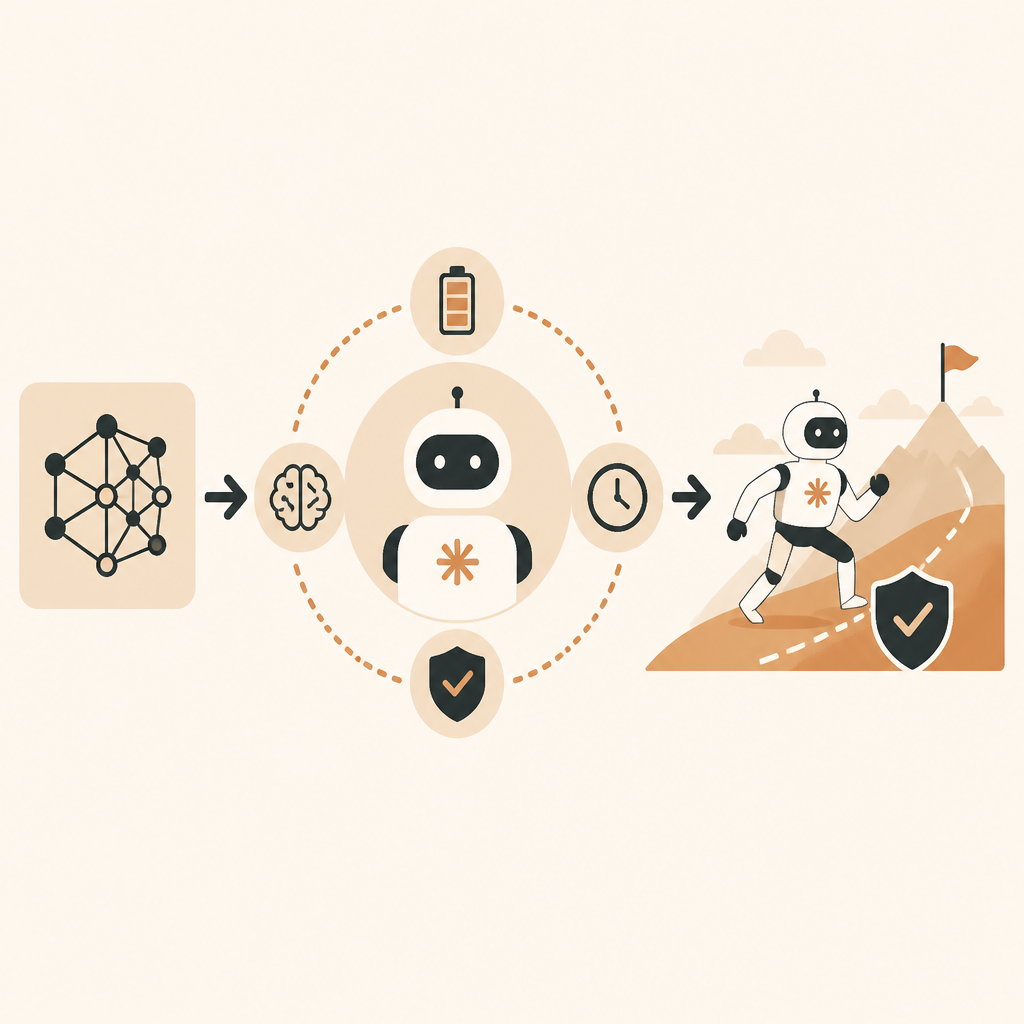
Use a stop rule that names the trigger, the action, and the fallback. If the task needs human input, say so directly.
If you need missing information, stop after one attempt and ask the user for the exact field you need.You should see the agent ask for help once instead of looping through repeated guesses or workaround attempts.
Step 3: Limit tool retries
Goal: prevent endless tool use by capping retries and defining what counts as a failed attempt.
Set a maximum retry count for each tool and tell the agent what to do after the limit is reached. This works well for search, file edits, and API calls.
Tool retry policy: 2 attempts max per tool. After that, return the last error and request human guidance.You should see the agent stop after the second failed attempt and surface the error instead of reissuing the same call.
Step 4: Separate work from approval
Goal: keep execution and decision-making in different phases, so the agent does not treat every prompt as a command to finish everything at once.
Structure the workflow as draft, review, and approve. The agent should only move to the next phase when the current phase is explicitly accepted.
Phase 1: propose options. Phase 2: wait for approval. Phase 3: execute only the approved option.You should see the agent present options first and wait, rather than choosing a path and running ahead.
Step 5: Log failure patterns
Goal: capture where the agent overcommits, so you can tune prompts and policies based on real behavior instead of guesswork.
Record the prompt, tool calls, retries, and the exact point where the agent should have stopped. Review these logs after each test run.
Log fields: task_id, prompt, tool_name, retry_count, stop_reason, human_override.You should see repeat failure patterns, such as ignored stop cues or excessive retries, become easy to spot in the logs.
Common mistakes
- Writing goals that are too broad. Fix: add a measurable output and a clear stop point.
- Allowing unlimited retries. Fix: cap retries per tool and define a fallback response.
- Mixing approval with execution. Fix: split the workflow into draft, review, and approve phases.
What's next
Once your agent can stop cleanly, move on to evaluation harnesses, policy-based tool routing, and human-in-the-loop review flows so persistence becomes reliability instead of drift.
// Related Articles
- [AGENT]
Google’s Gemini Enterprise Agent Platform makes agents a cloud servic…
- [AGENT]
WorkBuddy Proves Harness Engineering Matters More Than Model Size
- [AGENT]
Perplexity should build Teammate as a coding agent, not a copilot
- [AGENT]
HP adopts OpenAI Frontier across global operations
- [AGENT]
Build a production vector DB for RAG
- [AGENT]
Ornith-1 turns agent coding into a server