Anthropic's split from OpenAI, decoded
A plain-English breakdown of why Anthropic split from OpenAI, and how Dario Amodei's control over deployment shaped the break.

Anthropic split from OpenAI over control, not just safety.
I've been following the Anthropic and OpenAI story for a while, and honestly, the usual explanation always felt too neat. People love the tidy version: Anthropic cared more about alignment, so it broke away. That story is easy to repeat, and it sounds noble. But when I look at how these companies actually operate, the cleaner explanation starts to wobble. What I keep seeing is a fight over control, deployment, and who gets to own the commercial path from model to money. That is a much less flattering story, which is probably why it gets sanded down in retellings.
The source that pushed me to write this is a Zhihu answer by Trisimo 崔思莫 on Zhihu. The point being made there is blunt: Dario Amodei was not just worried about safety, he wanted total control over the business and deployment stack, and he did not want to be locked into Microsoft's terms. I am not quoting that as gospel, but it is a useful lens because it matches how hard these companies now fight over distribution, compute, and leverage over the customer relationship.
Safety was the slogan. Control was the argument.
Get the latest AI news in your inbox
Weekly picks of model releases, tools, and deep dives — no spam, unsubscribe anytime.
No spam. Unsubscribe at any time.
Anthropic 与 OpenAI 分家的原因... Dario Amodei 的商业化野心,控制欲比 Sam Altman 更强... Dario 反对的是 OpenAI 和微软签订的独家部署权。
What this actually means is that the split was not just a philosophical disagreement about model behavior. It was also a business disagreement about who gets to own the pipes. If one company controls the model, the cloud contract, the deployment channel, and the customer billing, then the other side is left with very little room to negotiate. That is not some abstract corporate nuance. That is the whole game.

I have seen this pattern in smaller teams too. The moment one partner owns the infrastructure and the customer access, your “strategic collaboration” starts to look like dependency. You can still ship, but you are shipping inside someone else’s box, on someone else’s terms. And once that box becomes successful, you are not partnering anymore. You are renting.
How to apply it: when you read a company story about “values” or “mission,” ask who controls deployment, billing, and distribution. Those three things tell you more than the blog post does. If those are centralized, then the real conflict is usually ownership, not ideology.
Exclusive cloud deals are not a footnote. They are the business.
OpenAI’s relationship with Microsoft is the obvious reference point here, and Microsoft’s own OpenAI page makes it clear enough that the partnership is deeply tied to Azure and commercial rollout. See Microsoft’s OpenAI page and OpenAI’s collaboration announcement. Once you accept that, the argument gets sharper: if your model is tied to an exclusive or semi-exclusive deployment path, you are not just selling intelligence. You are selling through a gatekeeper.
What this actually means is that compute contracts are strategic weapons. A model company that cannot freely choose where to run, how to price, or how to serve customers is constrained in ways that show up later as product limitations. The user sees an API. The company sees a dependency chain.
I ran into a smaller version of this when I helped a startup migrate from a single cloud arrangement. On paper, the deal looked fine. In practice, every pricing change and every latency issue had to be negotiated through one provider. By the time the team realized the cost, the architecture had already been shaped around the contract. That is the kind of lock-in people keep underestimating.
- Exclusive hosting can simplify launch, but it also narrows strategic options.
- When one partner owns the cloud and the customer path, pricing power shifts fast.
- Model companies that want independence usually have to fight for it early, not later.
How to apply it: if you are building an AI product, separate “can we ship?” from “who owns the commercial channel?” Those are different questions. If you skip that split, you may end up technically successful and strategically trapped.
Dario's real objection was probably not moral purity.
People often turn Dario Amodei into a safety monk, but that is too convenient. The source argument says his objection was stronger control over the full stack. That fits the behavior of a founder who wants to steer research, deployment, and economics in one direction without being boxed in by a giant partner. In other words, the issue was not just what the models should do. It was who gets to decide what happens after the model works.
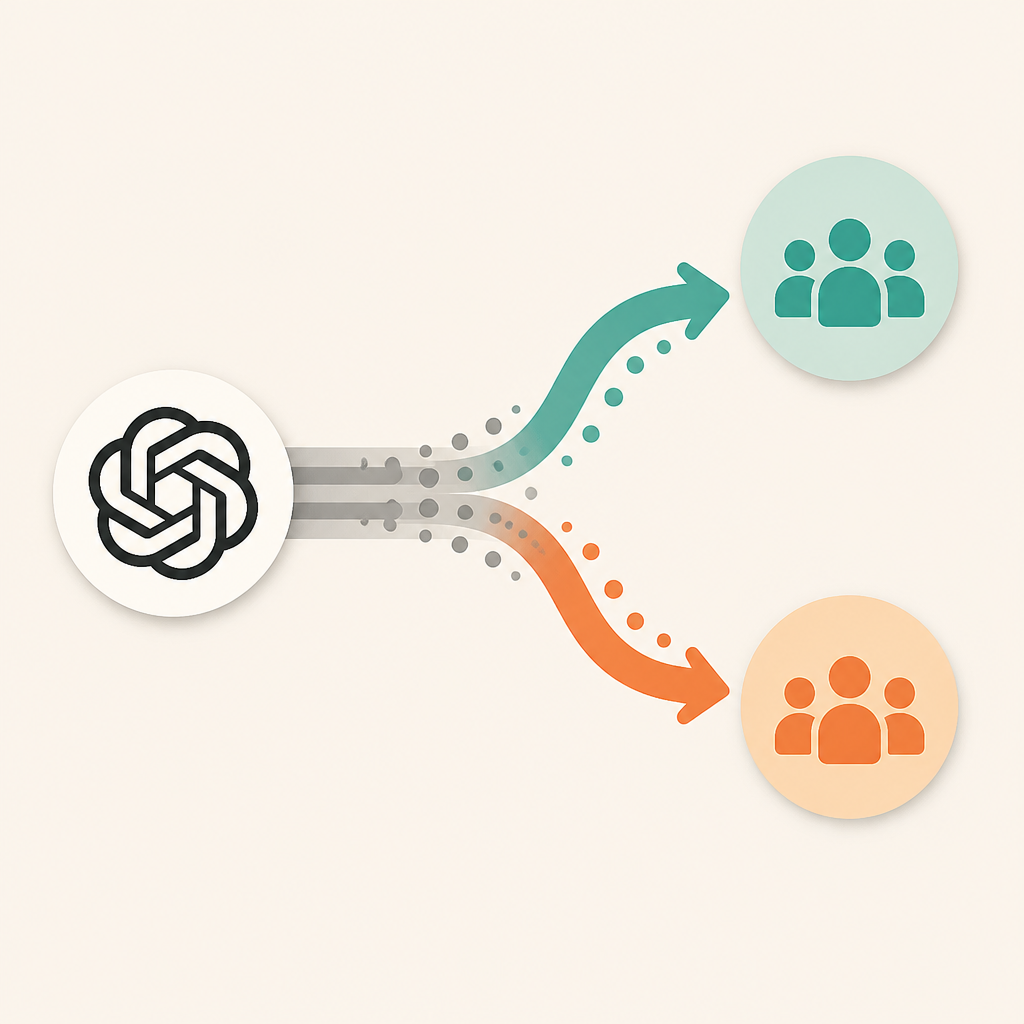
What this actually means is that control and safety are not opposites. A founder can sincerely care about safety and still care just as much about ownership. Those motivations are not mutually exclusive, and pretending they are makes the story worse. I think people prefer the “safety first” version because it is cleaner, but business history is almost never that clean.
When I look at founders who talk about independence, I usually hear two separate fears: being technically boxed in and being commercially boxed in. The second one is often the more painful one, because it determines whether the company can actually grow on its own terms.
How to apply it: if you are evaluating a partner, do not stop at their stated values. Ask what they refuse to outsource. If the answer is “everything important,” then expect conflict. That is not a red flag by itself, but it is a clue that the relationship is about control, not just collaboration.
OpenAI's later scramble makes the old concern look smarter.
The source text points out something important: OpenAI’s struggle to loosen itself from Microsoft’s grip ends up validating the concern that exclusive dependency is dangerous. That is not a victory lap. It is just a reminder that the risk was real. When a company has to unwind a major strategic tie later, the cost is not just financial. It is organizational. Product plans, go-to-market assumptions, and infrastructure choices all have to be reworked at once.
What this actually means is that a deal that feels safe in year one can become a headache in year three. The early upside is obvious: capital, compute, distribution, credibility. The later downside is equally obvious once you are inside it: less flexibility, slower negotiation, and a much weaker ability to say no.
I have watched teams celebrate a big platform partnership like it was a finish line. It is not. It is a trade. Sometimes it is a good trade. Sometimes it is the only trade available. But if you do not price in the eventual cost of escape, you are not being strategic. You are being optimistic in the wrong direction.
- Short-term access can hide long-term dependency.
- Escaping a dominant partner later is possible, but it is expensive and slow.
- Independence is easier to preserve than to recover.
How to apply it: before signing a major platform or cloud deal, write down the exit path. Not the legal exit path, the practical one. Where does the model run if the relationship goes bad? Who owns the customer data? Who can change pricing? If you cannot answer those, you are already making a bet.
Why people misread this story online.
Internet retellings like simple morality plays. One side is the safety-first team, the other is the profit-maximizer. That framing is comforting because it gives everyone a clean label. But the real story is uglier and more useful: serious AI companies are fighting over control of compute, deployment, and monetization while also talking about safety. Both things can be true at once.
What this actually means is that you should not trust the first explanation that sounds noble. In AI, the public narrative is often a layer placed on top of a much more ordinary business conflict. That does not make the noble narrative false. It just means it is incomplete.
I think this is why the Anthropic story keeps getting recycled in simplified form. “Safety company leaves Big Tech control” is easy to remember and easy to share. “Founders disagree over who owns the commercial stack and how much exclusivity is acceptable” is the real story, but it is less flattering and more annoying to explain. Still, that is the version worth keeping.
How to apply it: whenever a company story sounds too morally tidy, look for the contract underneath it. Follow the money, the compute, and the deployment rights. If those do not match the public narrative, the public narrative is probably doing PR work.
What I would take away if I were building today.
If I were starting an AI company now, I would treat deployment control as core architecture, not legal trivia. I would want to know where the model runs, who can move it, who bills the customer, and what happens if the partner relationship sours. Those decisions shape the company just as much as the model choice does.
What this actually means is that founders need to think like operators, not just researchers. The smartest model in the world is still constrained by the infrastructure and commercial path around it. If that path belongs to someone else, your model is only half yours.
I am not saying every partnership is bad. I am saying the cost of convenience is real, and the people who ignore it usually find out later, when it is much harder to unwind. The Anthropic and OpenAI split is a reminder that control is not a side issue. It is the issue.
The template you can copy
Title: [Company/Founder] split from [Partner], decoded

Summary: A plain-English breakdown of why [Company] split from [Partner], and how control over deployment shaped the break.

Opening angle:
- Start with the common story people tell.
- Then say why that story feels too neat.
- Frame the real conflict as control over deployment, billing, compute, or distribution.

Core sections:
1. The public story vs the real argument
   - Quote the claim from the source.
   - Explain what it means in plain English.
   - Show why values and business control can both be true.

2. The contract is the product
   - Point to the cloud, hosting, or platform deal.
   - Explain how exclusive access changes strategy.
   - Add one concrete example from your own experience.

3. Why the founder wanted control
   - Describe the founder's fear of being boxed in.
   - Separate safety concerns from commercial concerns.
   - Explain what total control buys a company.

4. Why the later scramble matters
   - Show how dependency becomes expensive to unwind.
   - Explain exit costs in product, infra, and go-to-market terms.
   - Make the lesson practical for builders.

5. What this means for new teams
   - List the questions to ask before signing a major partner deal.
   - Focus on deployment, billing, customer data, and exit paths.

Copy-ready checklist:
- Who controls deployment?
- Who owns the customer relationship?
- What happens if pricing changes?
- Can the model move to another cloud?
- What is the exit plan if the partnership breaks?

Template note:
Replace the bracketed names with your source company and partner. Keep the tone direct and skeptical of tidy narratives.
This is my own breakdown of the Zhihu answer by Trisimo 崔思莫. The original source is in Chinese, and the analysis here is derivative, translated, and reorganized into an English developer-facing template. For background reading, I also linked the relevant OpenAI and Microsoft partnership pages, plus Anthropic’s official site at anthropic.com.
// Related Articles
- [IND]
Open models beat safer ones when cyberattacks turn autonomous
- [IND]
OpenAI’s board adds bank CEOs for IPO prep
- [IND]
Anthropic’s $1.5B settlement is a warning, not a clean win
- [IND]
Project Glasswing turns AI into a security layer
- [IND]
Anthropic's IPO rumor turns into a market watch
- [IND]
Anthropic should not become dependent on Meta for compute