GPT-5.6 arrives in three variants with lower token costs
OpenAI’s GPT-5.6 ships in three tiers, cuts coding token use, and posts strong benchmark gains across coding and terminal tasks.

OpenAI’s GPT-5.6 ships in three tiers with lower token costs and stronger coding scores.
GPT-5.6 is OpenAI’s latest model family, and the headline is simple: it is built to do more work per token. The release arrived on July 9, 2026, after a limited preview on June 26, and OpenAI is pitching it as a better fit for coding, enterprise tasks, scientific research, and cybersecurity.
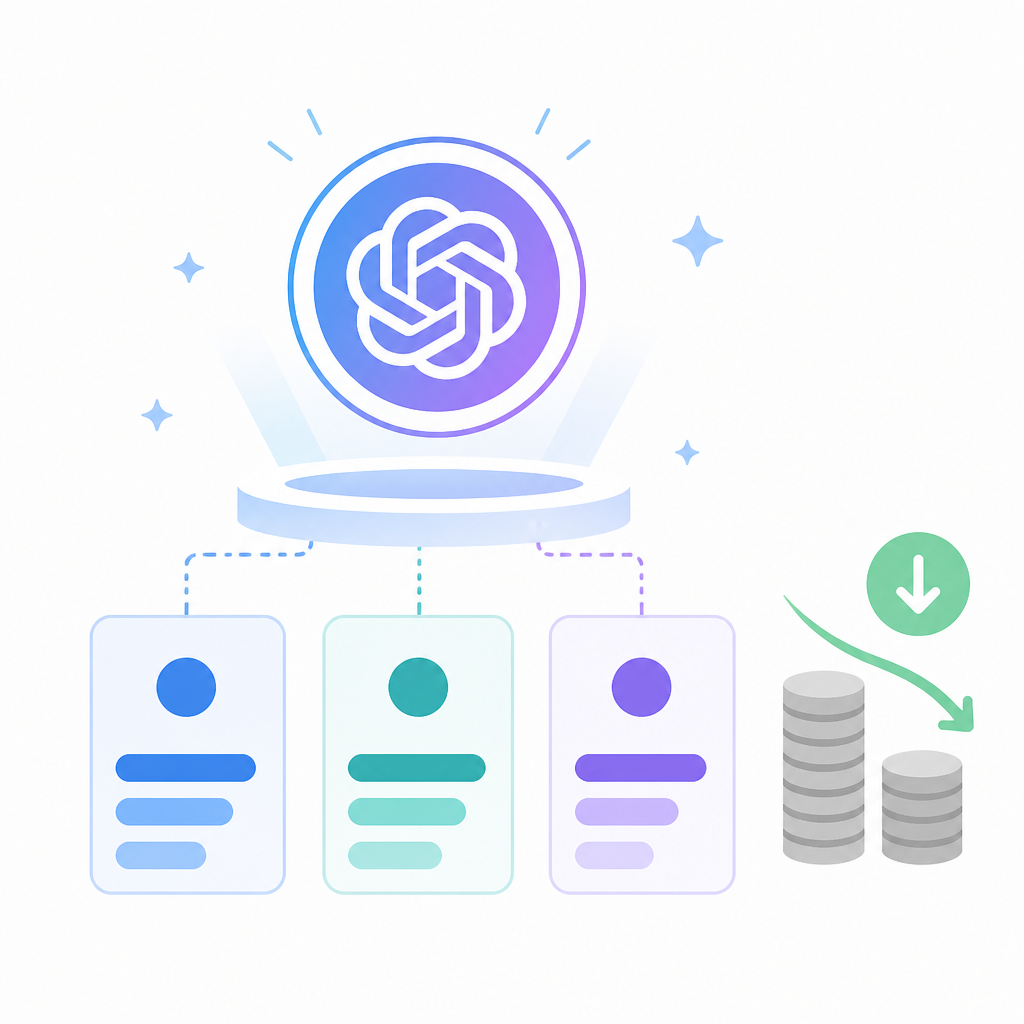
The model family has three variants, Sol, Terra, and Luna, plus a pricing spread that makes the trade-offs easy to see. OpenAI says Sol is its workhorse model, Terra is the cheaper middle option, and Luna is the fastest and least expensive member of the family.
| Metric | GPT-5.6 figure | What it means |
|---|---|---|
| Limited preview | June 26, 2026 | Early access before the public rollout |
| Public release | July 9, 2026 | General availability |
| Sol pricing | $5 input / $30 output per million tokens | Premium tier for heavier workloads |
| Terra pricing | $2.50 input / $15 output per million tokens | Mid-tier option |
| Luna pricing | $1 input / $6 output per million tokens | Lowest-cost option |
| Artificial Analysis Coding Agent Index | 80 for Sol | OpenAI’s top coding claim |
| TerminalBench 2.1 | 91.9% for Sol Ultra | Top terminal-agent result in the release notes |
OpenAI is selling efficiency, not just raw size
Get the latest AI news in your inbox
Weekly picks of model releases, tools, and deep dives — no spam, unsubscribe anytime.
No spam. Unsubscribe at any time.
OpenAI’s messaging around GPT-5.6 is more practical than flashy. Sam Altman said Sol is 54% more token-efficient for AI coding tasks than previous versions, which matters because token efficiency directly affects cost, latency, and how long an agent can keep working before a job gets expensive.

That framing also explains the three-model lineup. Teams that want the strongest reasoning and coding performance can pay for Sol, while product teams that care more about throughput or budget can choose Terra or Luna. In other words, OpenAI is trying to make one family cover multiple deployment styles instead of forcing everyone onto a single flagship model.
- Sol: highest capability, highest price, built for complex reasoning and agentic workflows.
- Terra: lower-cost middle ground, positioned as competitive with GPT-5.5 while costing about half as much.
- Luna: fastest and cheapest option, aimed at lighter or high-volume workloads.
The pricing makes the strategy obvious. Sol costs five times more than Luna on input tokens and five times more on output tokens, which is a meaningful gap for any company running large-scale agents or code review pipelines. The middle tier, Terra, is probably where a lot of product teams will land if they want better performance without paying flagship rates.
The benchmark story is strongest in coding
OpenAI is leaning hard on coding benchmarks, and that makes sense. The company says Sol scored 80 on the Artificial Analysis Coding Agent Index, which it claims is 2.8 points ahead of Anthropic’s Fable 5. OpenAI also says Sol reached that score while using less than half the output tokens, taking less than half the time, and costing about one-third less.
“Sol is our best coding model yet,” OpenAI said in its GPT-5.6 release materials.
That quote matters because it shows where OpenAI wants the market to focus. Coding is where users can measure gains quickly, and agentic coding is where token efficiency becomes a real business metric instead of a nice-to-have.
TerminalBench 2.1 gives the same picture, with GPT-5.6 posting strong results across the family. Sol Ultra reached 91.9%, Sol hit 88.8%, Terra landed at 87.4%, and Luna scored 84.7%. Those numbers are high enough to make the family look useful across different price points, which is exactly what OpenAI wants if it is trying to sell both premium and budget access.
- Sol Ultra: 91.9% on TerminalBench 2.1
- Sol: 88.8%, above Claude Mythos 5 at 88.0%
- Terra: 87.4%
- Luna: 84.7%, above Claude Opus 4.8 at 78.9%
There is still a caveat here: these are vendor-selected benchmarks, and benchmark wins do not always translate into better day-to-day developer experience. But the spread is wide enough that OpenAI clearly believes GPT-5.6 can compete on both quality and cost, which is the combination that tends to matter when teams decide what to wire into production.
Security is part of the product pitch
OpenAI is also treating GPT-5.6 as a security-sensitive release. Under its Preparedness Framework, all three models are rated “High capability” in cybersecurity and biological or chemical risk domains, but none cross into the “Critical” category. OpenAI says that means the models cannot autonomously carry out end-to-end attacks against hardened targets or create functional zero-day exploits without human help.
That is an important distinction because it places the release in the same conversation as defensive tooling, red teaming, and controlled access. OpenAI says it is using trusted access programs for cyber and biology research, reserving the most sensitive functions for vetted organizations and verified defensive work.
The timing also matters. GPT-5.6 was delayed from its expected June debut and first appeared as a limited preview on June 26, 2026, before becoming public on July 9. Reuters reported that the delay was tied to government restrictions under the Trump administration, which gives the release a policy angle that most model launches do not have.
That delay probably shaped the rollout more than OpenAI would like to admit. A preview-first launch can help a company gather feedback and manage risk, but it can also signal that frontier model releases are now part product launch, part regulatory event.
What GPT-5.6 says about the next model race
GPT-5.6 does not try to win by being a single giant model that does everything. It tries to win by splitting the market into tiers, then attaching real pricing and benchmark claims to each one. That is a smarter commercial move than simply pushing a bigger model name onto the market, because enterprise buyers can map Sol, Terra, and Luna to different workloads without guessing.
The bigger question is whether the industry will keep rewarding token efficiency as much as raw benchmark scores. If OpenAI’s numbers hold up in real deployments, the next round of competition will be about who can deliver the best agentic performance at the lowest cost per task, not who can post the flashiest single score.
For developers, the practical takeaway is straightforward: GPT-5.6 is worth watching if your stack depends on code generation, terminal automation, or security review. For everyone else, the interesting part is the pricing ladder. When a model family is split this cleanly, the real product is no longer just intelligence. It is how much intelligence you can buy for a fixed budget, and that is the metric that will decide where GPT-5.6 gets adopted next.
// Related Articles
- [MODEL]
GPT-5.6 Sol, Terra, Luna arrive on DigitalOcean
- [MODEL]
Grok 4.5’s rise comes down to 5 numbers
- [MODEL]
Grok 4.5 turns agent work into one prompt
- [MODEL]
Kimi API quickstart adds K2.7 Code and Highspeed
- [MODEL]
GPT-Live brings faster voice chat to ChatGPT
- [MODEL]
Anthropic extends Claude Fable access after GPT-5.6