What We Know About GPT-5.6's Release Date
OpenAI has not announced GPT-5.6, but hiring, infrastructure work, and model rumors point to a late-2024 or early-2025 window.

OpenAI has not announced GPT-5.6, but signs point to a late-2024 or early-2025 window.
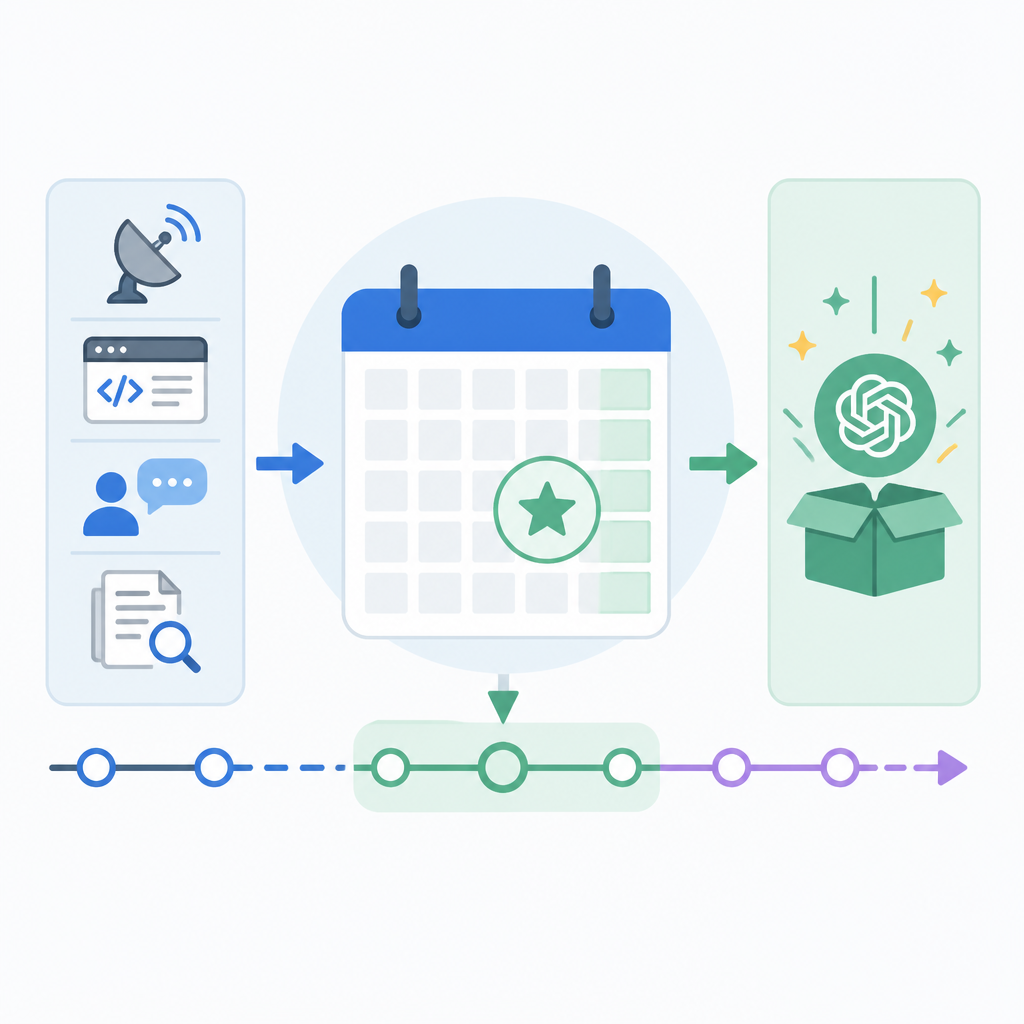
OpenAI has not confirmed a GPT-5.6 launch date, yet the rumor mill keeps circling the same window: late 2024 or early 2025. That guess is built from a few concrete signals, including hiring for inference infrastructure, references to future releases, and the company’s past release cadence.
| Signal | What it suggests | Source detail |
|---|---|---|
| GPT-3 | Mid-2020 debut | 175 billion parameters |
| GPT-4 | Early-2023 debut | Multimodal support |
| GPT-4 Turbo | Later-2023 update | 128K-token context window |
| Rumored GPT-5.6 | Late-2024 or early-2025 window | 200K-token context, 2.5× faster inference |
Why people think GPT-5.6 is close
Get the latest AI news in your inbox
Weekly picks of model releases, tools, and deep dives — no spam, unsubscribe anytime.
No spam. Unsubscribe at any time.
The strongest argument for an upcoming model is OpenAI’s own behavior around staffing and infrastructure. Job listings for next-generation inference systems and multimodal training pipelines usually mean the company is preparing for heavier model traffic, larger inputs, or both.

That matters because bigger context windows and richer multimodal features are expensive to run. If OpenAI is hiring for those systems now, it implies the company is doing the unglamorous work long before a public announcement.
There is also a pattern worth watching. GPT-3 arrived in 2020, GPT-4 in 2023, and GPT-4 Turbo later that same year. That is not a perfect schedule, but it does suggest OpenAI tends to ship major jumps on a multi-year rhythm rather than every few months.
- GPT-3: mid-2020, 175B parameters
- GPT-4: early 2023, multimodal
- GPT-4 Turbo: late 2023, 128K context window
- Rumored GPT-5.6: late 2024 or early 2025
What the rumor mill says about the model
The clearest claims around GPT-5.6 are about capability, not just timing. The model is rumored to support a 200K-token context window, stronger reasoning, and broader multimodal input that could include text, images, audio, and video.
Those are big claims, and they would place the model well beyond GPT-4 Turbo in practical use. A 200K-token window changes how teams work with long documents, product catalogs, and research archives, because fewer prompts are needed to keep a project in memory.
“The next model will not only push the boundaries of language understanding but also bring a new level of multimodality that we believe will redefine how AI integrates into everyday business workflows.” — OpenAI spokesperson, March 2024
That quote matters because it is one of the few public hints that sounds like roadmap language without naming a release date. It does not confirm GPT-5.6, but it does confirm that OpenAI expects the next wave of models to be more multimodal and more useful in business settings.
One widely circulated figure says inference could be 2.5× faster than GPT-4. If that number holds, the impact would be felt most in customer support, translation, and any workflow where latency directly affects cost or user experience.
How GPT-5.6 could compare with earlier models
Comparisons are always rough when the newest model is still a rumor, but the numbers in circulation are specific enough to sketch a useful picture. The jump from 8K to 128K tokens already changed what teams could do with GPT-4 Turbo. A move toward 200K tokens would push that further.
Here is the practical difference: GPT-4 can handle a long exchange, GPT-4 Turbo can handle a much larger body of text, and a rumored GPT-5.6 could process enough context to keep entire workflows inside one session instead of splitting them into fragments.
- Context: GPT-4 at 8K tokens, GPT-4 Turbo at 128K, rumored GPT-5.6 at 200K
- Speed: GPT-4 baseline, GPT-4 Turbo about 1.5× faster, rumored GPT-5.6 about 2.5× faster
- Inputs: GPT-4 text plus images, GPT-4 Turbo text plus images plus audio, rumored GPT-5.6 text plus images plus audio plus video
- Safety: GPT-4 RLHF, GPT-4 Turbo enhanced RLHF plus constitutional AI, rumored GPT-5.6 next-gen alignment techniques
Those numbers are why developers keep paying attention even when OpenAI stays quiet. A bigger context window changes prompt design, memory strategies, and retrieval architecture. Faster inference changes unit economics. Better multimodal support changes what counts as a single request.
What teams should do before the launch
If you build with OpenAI models today, the safest move is preparation, not speculation. Start by auditing your current API calls and looking for places where a larger context window could replace a chain of smaller requests.
That one change can reduce latency and simplify application logic. It also makes your stack easier to adapt if GPT-5.6 arrives with the kind of long-context support people are expecting.
Next, test your multimodal pipeline. If your product already handles images or audio, check whether your storage, moderation, and retrieval layers can handle video too. A new model is only useful if the rest of your system can feed it clean inputs.
You should also review safety controls. More reasoning power does not remove bias, hallucinations, or policy issues. It can make them harder to spot if your review process is weak.
- Audit long prompts and multi-call workflows
- Test image, audio, and video ingestion paths
- Review moderation and human review steps
- Track OpenAI’s blog for official announcements
For teams already experimenting with AI workflows, this is also a good time to benchmark against internal standards rather than vendor hype. If GPT-5.6 is faster, cheaper, or better at long-context reasoning, you will want numbers from your own workloads, not just launch-day claims.
Related reading: How GPT-4 Turbo changed long-context workflows.
The real question is not the date
The release date matters, but the bigger story is what kind of product OpenAI is preparing. The evidence points to a model that is less about a single benchmark win and more about practical usefulness across documents, media, and business automation.
If that is right, then the first companies to benefit will be the ones that already have clean data pipelines, clear moderation rules, and a plan for human review. The rest will spend launch week trying to catch up.
My bet: if OpenAI does ship a GPT-5.6-class model in the next cycle, the first public signal will come from infrastructure or safety updates before a polished product announcement. Watch the job posts, the docs, and the release notes, because that is where the real timeline usually shows up first.
// Related Articles
- [MODEL]
GPT-5.6 arrives in three variants with lower token costs
- [MODEL]
GPT-5.6 Sol, Terra, Luna arrive on DigitalOcean
- [MODEL]
Grok 4.5’s rise comes down to 5 numbers
- [MODEL]
Grok 4.5 turns agent work into one prompt
- [MODEL]
Kimi API quickstart adds K2.7 Code and Highspeed
- [MODEL]
GPT-Live brings faster voice chat to ChatGPT