Why Prompt Engineering Is Wrong About 2026
Prompt engineering is giving way to context engineering, and structured frameworks win because they reduce errors and improve repeatability.

Context engineering, not prompt tricks, is what makes AI systems work in 2026.
Prompt engineering is no longer the main skill that separates good AI output from bad; context engineering is.
The evidence is already in the research and in daily practice. Jason Wei’s Chain-of-Thought work showed that eight well-crafted examples could push a 540-billion-parameter model past fine-tuned GPT-3 on GSM8K, which is a brutal reminder that structure beats vague instruction. Anthropic has also made the shift explicit in its engineering writing on effective context engineering for AI agents, and LangChain formalized the idea in programmatic terms in 2025. The old habit of typing “write me something good about X” is not just lazy. It is the wrong abstraction for the way modern models behave.
First argument: structure beats improvisation
Get the latest AI news in your inbox
Weekly picks of model releases, tools, and deep dives — no spam, unsubscribe anytime.
No spam. Unsubscribe at any time.
Language models do not reason like humans; they predict the next token from the context you give them. That makes the prompt less like a spell and more like a specification. When you define role, task, format, audience, and constraints, you are not decorating the request. You are reducing ambiguity, which is the real source of bad outputs.

The simplest frameworks prove the point. RTF, TAG, and TASS work because they force the user to make decisions before the model does. A prompt that says “You are a sports nutritionist, create a 7-day meal plan, return an HTML table” is not just clearer than a casual request. It is cheaper to run, easier to reproduce, and much less likely to wander into irrelevant prose. That is why these frameworks cover most everyday use cases and why they will outlive the trendier prompt hacks.
Second argument: examples matter more than clever wording
The strongest practical lesson from the research is that examples beat abstraction. Brown’s 2020 work on few-shot learning showed that GPT-3 could match or exceed fine-tuned models on specific tasks when given 10 to 100 examples. That finding demolished the old assumption that model quality depended mainly on training updates. In many real workflows, the fastest path to better output is not a better adjective. It is a better example.
That is why CARE and CREATE are more useful than most people admit. CARE works because the final E for Example turns a vague request into a pattern the model can imitate. CREATE goes further by adding additions and extras, including negative constraints. In practice, “do not mention competitors,” “avoid inflated claims,” and “do not open with a rhetorical question” often improve output more than a page of positive instructions. This is not stylistic fussiness. It is control.
The second argument: reasoning frameworks are for hard problems, not all problems
Once the task gets complex, the lightweight frameworks are not enough. Chain-of-Thought, Tree of Thoughts, ReAct, and Self-Refine exist for a reason: they make the model expose intermediate steps instead of guessing in one shot. The numbers are not subtle. In the Game of 24 benchmark, standard CoT solved only 4% of problems, while Tree of Thoughts jumped to 74%. That is not a marginal gain. It is the difference between a toy and a tool.
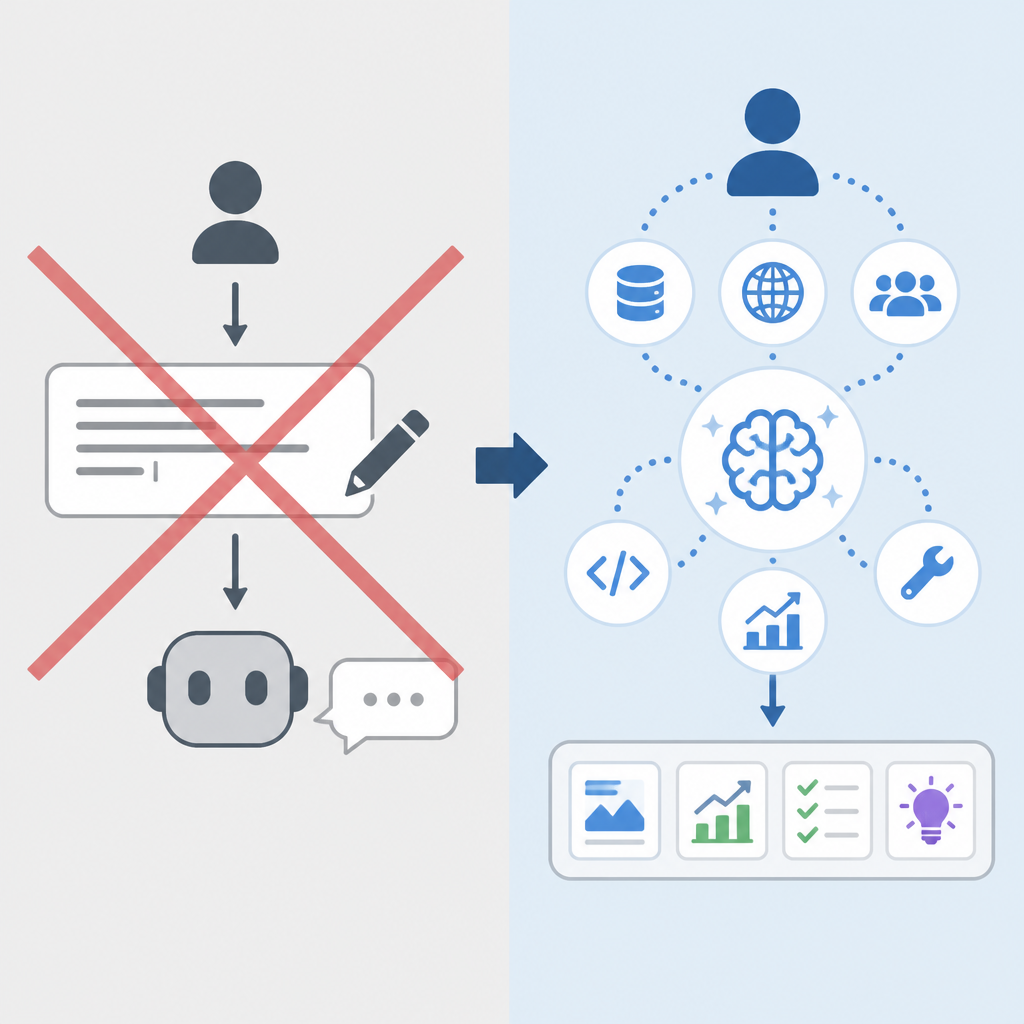
ReAct is the clearest sign that the field has moved beyond prompting as a standalone craft. In the benchmark literature, alternating reasoning with external action beats static text-only answering because the model can search, calculate, and verify. That pattern now powers agentic workflows across the stack. If your use case involves tools, retrieval, or multi-step decisions, the prompt is only the first layer. The real system is the context pipeline around it.
The counter-argument
The best defense of old-school prompt engineering is that it is still the fastest way to get value from general-purpose chatbots. For a marketer drafting copy, a founder summarizing notes, or an engineer generating a quick code snippet, a good RTF prompt is often enough. It is also true that many people do not need agent stacks, retrieval layers, or programmatic orchestration. They need a clean request and a consistent format.
That argument is correct, but only up to the point where the task stops being one-off. The moment output quality must be repeatable, auditable, or embedded in a product, “prompting” becomes too small a word. Context engineering is not a buzzword replacement. It is the right label for the real job: selecting inputs, examples, tools, constraints, memory, and retrieval so the model can do useful work reliably. Prompting is a tactic. Context engineering is the system.
What to do with this
If you are an engineer, stop optimizing for clever wording and start optimizing for input design: define schemas, add examples, enforce negative constraints, and wire in retrieval or tools when the task requires facts or actions. If you are a PM, treat prompts as interfaces and measure output quality the same way you measure product quality: consistency, latency, failure modes, and user trust. If you are a founder, build your AI features around context pipelines, not prompt libraries. In 2026, the teams that win will not be the ones with the fanciest prompt templates. They will be the ones who understand that the model is only as good as the context they give it.
// Related Articles