Why Tether Is Right to Push Local AI Memory Into Everyday Devices
Tether’s TurboQuant matters because it makes long-context AI practical on local devices, not just in data centers.

TurboQuant makes long-context AI practical on local devices, not just in data centers.
Tether is right to push TurboQuant into QVAC SDK because the real bottleneck in useful AI is memory, not model hype. Once a session stretches beyond a few prompts, the KV cache balloons, and that is what forces assistants, coding tools, and document analyzers back into the cloud. Tether’s own example is blunt: a 4B model at around 262,000 tokens can burn roughly 8 GB of memory just for cache, and four such sessions can consume about 32 GB before the model is even loaded. That is not a niche constraint. It is the reason so many “local AI” products quietly stop being local the moment they become useful.
Local AI fails when memory, not compute, runs out
Get the latest AI news in your inbox
Weekly picks of model releases, tools, and deep dives — no spam, unsubscribe anytime.
No spam. Unsubscribe at any time.
The strongest case for TurboQuant is simple arithmetic. A laptop or phone can often run a model once, but it cannot always keep a long conversation, a large document, or a codebase in working memory without choking. If the KV cache grows linearly with session length, then every extra page or turn becomes a tax on deployment. Compressing that cache up to 5x is not a cosmetic gain. It is the difference between a demo and a tool people can actually rely on for real work.

This matters because most practical AI tasks are not one-shot prompts. They are long threads: legal review, research synthesis, incident response, tutoring, coding, and private note analysis. In each case, context is the product. If the system forgets too early, the user gets a reset button instead of an assistant. Tether is correct to treat memory compression as infrastructure, because local AI will not scale by asking users to buy bigger GPUs every time they want a longer session.
Open source is the only credible way to make this portable
TurboQuant’s value is not just that it exists, but that Tether is shipping it as open source inside a production path. That is the right move. Research results often die in papers because teams must reimplement them, tune them, and bolt them onto messy inference stacks. By packaging the algorithm with a full quantization pipeline, adapters, documentation, and workload-tuned profiles, Tether turns a research claim into something developers can test on consumer GPUs, mobile chips, edge devices, and decentralized networks.
That portability is the real strategic win. If this capability lived only inside a single proprietary API, it would just deepen dependence on centralized cloud providers. Instead, an open implementation gives startups and independent developers a shared base layer for local assistants, offline tools, and privacy-sensitive products. It also lowers the cost of experimentation. A small team can build for longer context without first buying into a hyperscale deployment model. That is how an ecosystem forms: not through slogans about decentralization, but through code that runs on ordinary hardware.
The counter-argument
The best objection is that compression always trades something away. Even if TurboQuant preserves output quality closely, it is still a form of approximation layered onto a system that is already probabilistic. Enterprises care about reproducibility, auditability, and worst-case behavior, not just average benchmark scores. From that angle, the cloud still wins because it offers simpler operations, centralized monitoring, and easier capacity planning. If a vendor can guarantee large context windows on hosted infrastructure, why risk another layer of optimization on the client side?
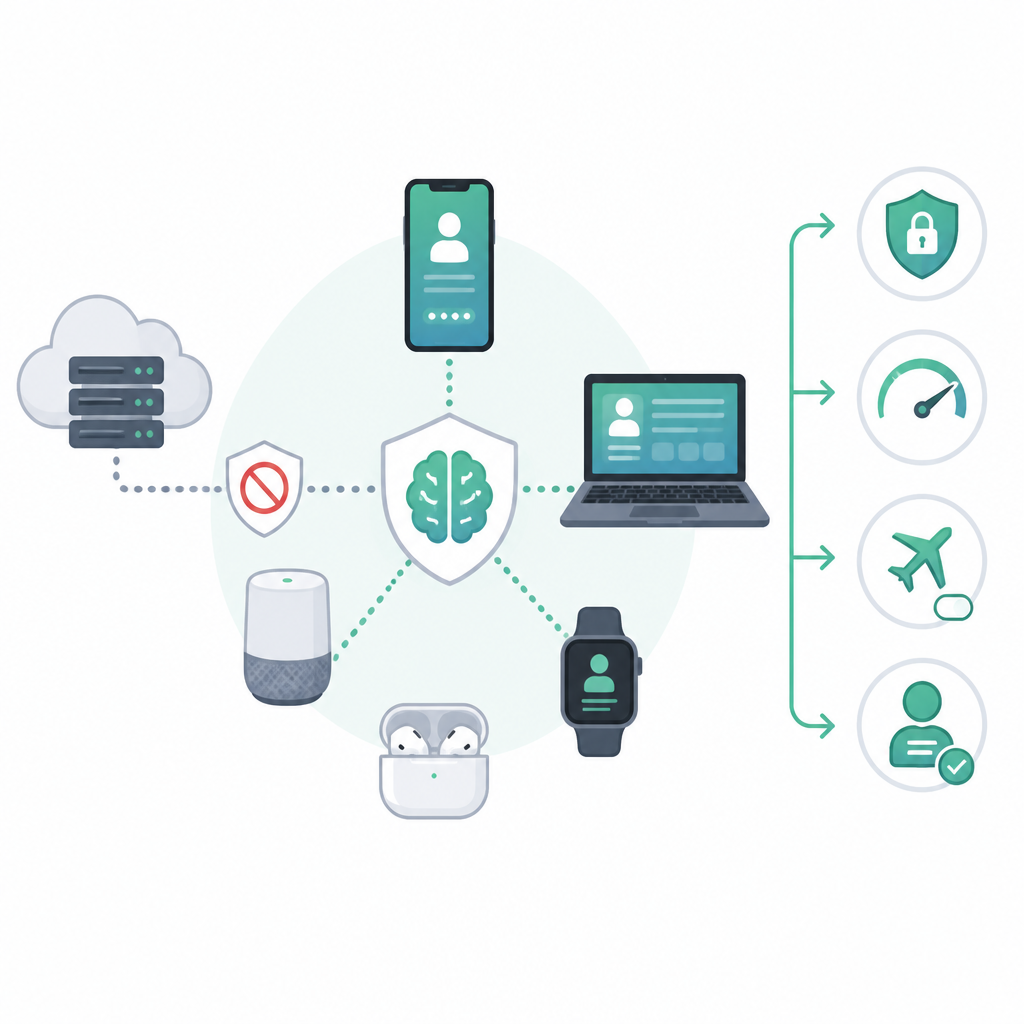
That objection is serious, but it does not defeat the case for TurboQuant. It only defines the boundary. Cloud AI will remain necessary for the largest workloads, the heaviest training jobs, and the most demanding enterprise deployments. But that does not change the fact that a huge share of daily AI use is blocked by memory limits on devices people already own. For those tasks, the choice is not between perfect local AI and perfect cloud AI. It is between useful local AI and no local AI at all. TurboQuant expands the first category enough to matter.
What to do with this
Engineers should stop designing local AI around short prompts and start treating memory as a first-class product constraint. If you build assistants, coding tools, or document workflows, test them against long sessions, large files, and real device limits, then profile where the KV cache breaks your UX. PMs should frame success in terms of retained context, offline continuity, and privacy-preserving workloads, not just token throughput. Founders should look at TurboQuant as a distribution strategy: ship where the user is, keep sensitive data on-device when possible, and use the cloud only when the workload truly demands it.
// Related Articles
- [TOOLS]
Docker Desktop on Windows in one clean install flow
- [TOOLS]
Grok 4.5 hits Cursor with $2/$6 pricing
- [TOOLS]
AGT turns agent calls into governed actions
- [TOOLS]
OpenClaw v2026.7.1 turns control UI into a workspace
- [TOOLS]
OpenAI’s screenless speaker turns ChatGPT into a companion
- [TOOLS]
SCALE turns CUDA code into portable GPU builds