Fine-Tuning SLMs Turns Enterprise AI Practical
I break down CogitX’s SLM fine-tuning playbook and give you a copy-ready template for enterprise training, eval, and deployment.

I break down CogitX’s SLM fine-tuning playbook and give you a copy-ready template for enterprise training, eval, and deployment.
I've been watching enterprise teams bolt frontier LLMs onto workflows for a while now, and honestly, it keeps starting the same way: a shiny API, a pile of prompts, and a month later everyone is annoyed. The model is too chatty, too expensive, too slow, or it keeps wandering off into generic answer-land when the business needs a very specific output. I've seen teams try to patch that with more prompting, more guardrails, more “just one more system message,” and it usually turns into a mess.
What finally clicked for me was this: a lot of enterprise problems are not “need a smarter model” problems. They’re “need a smaller model that behaves exactly the way we want” problems. That’s why CogitX’s breakdown of fine-tuning small language models hit a nerve. They’re not selling ideology here. They’re talking about cost, latency, governance, and boring operational control. Which, in enterprise work, is usually the real story anyway.
I’m breaking down their article from CogitX’s blog post, and I’m also pulling in a few reference points from Hugging Face PEFT, vLLM, and QLoRA because the practical details matter more than the marketing copy.
Enterprise teams are not fine-tuning for fun
Get the latest AI news in your inbox
Weekly picks of model releases, tools, and deep dives — no spam, unsubscribe anytime.
No spam. Unsubscribe at any time.
“The motivations are operational, not ideological. Cost, latency, data governance, and deployment control are driving forces.”
What this actually means is that most teams don’t wake up wanting to maintain a model. They get shoved into it by reality. The API bill gets ugly. The response time is bad enough that users complain. Legal says the data cannot leave the building. Or the model keeps drifting because the vendor changed something upstream and nobody warned the people who own the workflow.

I’ve run into this exact pattern in support automation and internal copilots. The first version is always a general model with a decent prompt. It demos well. Then traffic rises, edge cases show up, and suddenly you’re paying premium rates for a model that still misses the same contract clause or classifies the same ticket wrong. At that point, fine-tuning stops being an ML hobby and starts being a systems decision.
CogitX frames this well: if the task is narrow, repetitive, and sensitive to latency or governance, a smaller model with the right training data is often the saner choice. That doesn’t mean “always fine-tune.” It means the default assumption should be economics and control, not model size worship.
How to apply it: start by writing down the actual failure mode. Is it cost per request? Time to first token? Output format drift? Data residency? If you can name the pain clearly, you can tell whether fine-tuning is solving it or just making the team feel productive.
- Use API LLMs when the task is broad, changing, or exploratory.
- Use SLM fine-tuning when the task is bounded and repeated thousands of times.
- Use both when you need retrieval plus behavior shaping.
Most of the win comes from boring, narrow tasks
CogitX calls out the kinds of workflows where fine-tuning tends to work: ticket classification, entity extraction, document routing, structured summarization, HR policy Q&A, and other tasks where the input space is bounded and the output format matters. That’s the part a lot of teams miss. They try to fine-tune a model into being a general assistant, then act surprised when it doesn’t magically become a better version of a frontier model.
What this actually means is that fine-tuning is strongest when the model is learning a pattern, not a universe of facts. If the answer is mostly “map this input to this schema,” training beats prompting. If the answer depends on live data or constantly changing policy, fine-tuning starts to look clumsy fast.
I’ve seen this in document processing. A base model can usually understand the words, but it will still output half-valid JSON, invent fields, or miss the exact normalization rules the downstream system expects. Once you fine-tune on a clean set of examples, the model stops improvising so much. It becomes less clever, which is exactly what you want.
How to apply it: make a shortlist of tasks that are repetitive, measurable, and annoying to prompt-engineer. If you can define success with a schema, a label set, or a fixed response style, that’s a better fine-tuning candidate than a vague “assistant” use case.
- Good candidates: classification, extraction, routing, templated summaries.
- Poor candidates: live facts, open-ended research, fast-changing policies.
- Borderline candidates: domain copilots that need both retrieval and format discipline.
LoRA and QLoRA are the reason this is practical
CogitX leans on LoRA and QLoRA, which is the right call. For most enterprise teams, full fine-tuning is overkill and expensive. LoRA freezes the base model and trains small low-rank adapter weights instead. QLoRA goes further by loading the base model in 4-bit quantization while training adapters in higher precision. That lets teams fine-tune a 7B model on much smaller hardware than full-precision training would require.
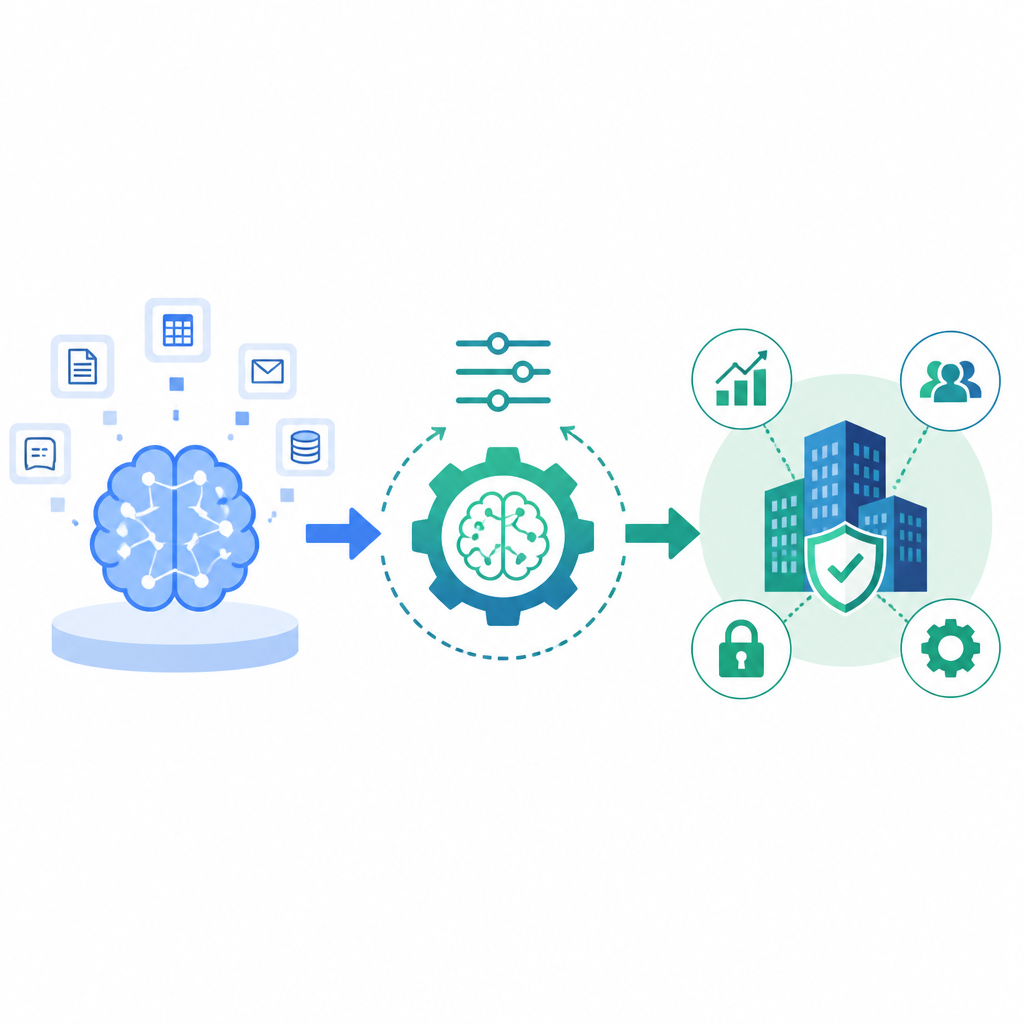
What this actually means is that you do not need a giant GPU farm to get real value out of fine-tuning. You need a competent training pipeline, enough representative data, and a model that is already close to the task. That’s why the ecosystem around PEFT matters so much. It makes adapter-based training the default instead of some custom research project your infra team resents.
I’ve been in teams where the training discussion died because people assumed “fine-tuning” meant burning through a cluster budget. That’s old thinking. With LoRA-style approaches, the bottleneck is usually not compute. It’s whether the dataset is clean enough to teach the behavior you actually want.
How to apply it: if you’re starting from scratch, use PEFT for LoRA, and only move to something more exotic if you have a concrete reason. If you care about throughput at serving time, look at adapter-aware serving tools like vLLM and multi-adapter approaches such as S-LoRA.
Instruction tuning is where the model learns your house style
CogitX’s article is blunt about this: the quality of instruction-response pairs matters more than hyperparameter heroics. I agree. Too many teams obsess over rank, batch size, and learning rate before they’ve even checked whether their examples are consistent. That’s backwards.
Instruction tuning means you train on pairs that look like real work. Not raw text. Not random snippets. Actual instructions and the outputs you want. If your support team wants a polite answer with escalation logic, train that. If your legal workflow needs a JSON object with exact fields, train that exact object.
What this actually means is that the model is learning your organization’s habits. Tone, formatting, refusal behavior, and “when to stop talking” are all trainable. That’s why instruction tuning is such a good fit for enterprise work. Businesses care less about creative brilliance and more about repeatable behavior.
I ran into this with a procurement assistant that kept answering in paragraphs when the downstream system needed structured fields. Prompting helped for a day. Fine-tuning fixed it because the model saw enough examples of the exact output pattern to stop freelancing.
How to apply it: build examples from real workflows, not synthetic toy prompts. Every sample should answer one question: “What should the model do when a human asks this?” If you can’t write the desired response yourself, you probably don’t have a training target yet.
Data quality is the whole game, and synthetic data is useful if you’re careful
CogitX spends a lot of time on data preparation, and that’s where I’d spend my time too. They call out internal documents, conversation logs, and synthetic data as the main sources. That tracks. But the important bit is not “more data.” It’s “clean, consistent, representative data.”
What this actually means is that a smaller clean dataset can beat a bigger noisy one. Deduping matters. Schema normalization matters. Removing PII matters. Making sure the model sees the same instruction style across examples matters. If the labels are fuzzy, the model learns fuzziness. If the outputs are inconsistent, the model becomes inconsistent.
The synthetic data point is worth keeping. CogitX references Scale AI’s NeurIPS 2024 research on synthetic generation strategies, and that aligns with the broader pattern I’ve seen: synthetic data works when it is grounded in real source material and generated with a sane strategy. It fails when teams just ask a model to make stuff up and call it training data.
How to apply it: use synthetic generation to expand coverage, not to replace domain truth. Start with a small gold set from real workflows, then generate variants around that set. Validate the output against schema and domain rules before it ever touches training.
- Source from internal docs, logs, and human-labeled outputs.
- Normalize fields and output formats before training.
- Keep a gold evaluation set separate from training data.
RAG and fine-tuning are not enemies
CogitX is right to say this is the most practical architectural question. People keep treating retrieval-augmented generation and fine-tuning like they’re competing religions. They’re not. They solve different problems.
RAG is better when the knowledge changes often, when you need citations, or when access control differs by user. Fine-tuning is better when the behavior itself needs to change: format, tone, schema adherence, routing logic, refusal style, or domain-specific pattern recognition. If you try to make fine-tuning do live knowledge retrieval, you’re using the wrong tool. If you try to make RAG teach the model how to behave, you’re also using the wrong tool.
What this actually means is that the best enterprise systems often use both. RAG provides fresh facts and traceability. Fine-tuning teaches the model how to respond once those facts are in context. That hybrid setup is usually much more realistic than trying to make one mechanism carry the whole stack.
I’ve seen this work well in compliance workflows. The retrieval layer pulls the current policy, and the fine-tuned model formats the answer exactly the way legal wants it. That split is cleaner than asking a single prompt to do everything and hoping the model stays obedient.
How to apply it: ask two separate questions. First, “Does this task need fresh knowledge?” If yes, use retrieval. Second, “Does this task need stable behavior?” If yes, fine-tune. If both answers are yes, combine them instead of forcing a false choice.
Deployment is where the theory gets punched in the mouth
CogitX mentions on-prem serving, quantization, and inference tooling, and that’s where the paper cuts show up in real life. Training is only half the story. If the model is slow, hard to update, or impossible to monitor, the project still fails.
What this actually means is that deployment constraints should shape model choice from day one. A 7B model served with vLLM on a single GPU can be a very different operational story from a huge hosted API. You get more control, lower latency, and better data residency, but you also own uptime, patching, adapter versioning, and rollback.
I’ve watched teams underestimate this part and then regret it immediately. They train a decent adapter, ship it, and then discover nobody defined how to validate it against production inputs before swapping versions. That is how you turn a model improvement into a support incident.
How to apply it: treat model releases like software releases. Version the base model, the adapter, the dataset, and the evaluation set. Put a rollback path in place. Measure latency, throughput, and failure rate in production, not just offline accuracy.
The template you can copy
## Enterprise SLM Fine-Tuning Playbook

### 1) Pick the right task
Use fine-tuning only when the task is:
- repetitive
- bounded
- measurable
- sensitive to format, tone, or routing

Do not fine-tune for:
- live facts
- open-ended research
- fast-changing policy
- broad general assistance

### 2) Define the behavior
Write the exact behavior you want in one sentence:
- input type
- output schema
- tone
- refusal rules
- escalation rules

Example:
"Given a support ticket, classify the issue, extract entities, and return valid JSON with one of five labels."

### 3) Build the dataset
Sources:
- internal documents
- human-labeled workflow outputs
- conversation logs
- synthetic variants grounded in real examples

Dataset rules:
- remove PII
- dedupe semantically
- normalize formatting
- keep a separate gold eval set
- reject ambiguous labels

### 4) Use instruction tuning format
Train on instruction-response pairs.

Example:
{
  "instruction": "Extract contract parties and effective date.",
  "context": "This Agreement is entered into as of January 1, 2025...",
  "response": "{\"parties\":[\"Acme Corp\",\"Vertex Ltd\"],\"effective_date\":\"2025-01-01\"}"
}

### 5) Start with LoRA or QLoRA
Recommended default:
- base model: 7B to 8B open-weight model
- fine-tuning method: LoRA
- if GPU memory is tight: QLoRA
- serving: vLLM or similar adapter-aware runtime

### 6) Evaluate before shipping
Use both:
- task metrics: exact match, F1, schema validity, routing accuracy
- human review: edge cases, tone, refusal behavior

Never ship without a held-out eval set.

### 7) Decide if RAG should stay in the stack
Use RAG when:
- facts change often
- citations matter
- access control differs by user

Use fine-tuning when:
- behavior must be stable
- output format must be exact
- latency matters

Use both when the system needs fresh facts and stable behavior.

### 8) Deploy like software
Track:
- base model version
- adapter version
- dataset version
- eval set version
- latency
- throughput
- rollback path

### 9) Production checklist
- [ ] schema validation passes
- [ ] PII removed
- [ ] eval set locked
- [ ] rollback tested
- [ ] latency measured under load
- [ ] human review on edge cases
- [ ] monitoring alerts defined

### 10) Simple decision rule
If the task is narrow and repetitive, fine-tune.
If the task needs fresh facts, add RAG.
If the task needs both, combine them.
If the task is broad and unstable, do not force fine-tuning.
That’s the version I’d hand to a team before they start burning time on random experiments. It’s not fancy. It just forces the right questions in the right order, which is usually what’s missing.
The original CogitX article is at https://cogitx.ai/blog/fine-tuning-slms-for-enterprise-use-cases. My breakdown is derivative of that source, but the framing, checklist, and copy-ready template here are my own synthesis for developers trying to ship this stuff without making a mess.
// Related Articles
- [AGENT]
Grok Build adds live previews and rewind fixes
- [AGENT]
Kimi K3 Benchmark Evaluation Guide for Coding Agents
- [AGENT]
Meta’s first paid model proves AI coding is now a price war
- [AGENT]
Claude Code turns chat into terminal work
- [AGENT]
Decentralized AI compliance should be built into agent rails, not bol…
- [AGENT]
Open-Source AI Agent Frameworks Compared